
















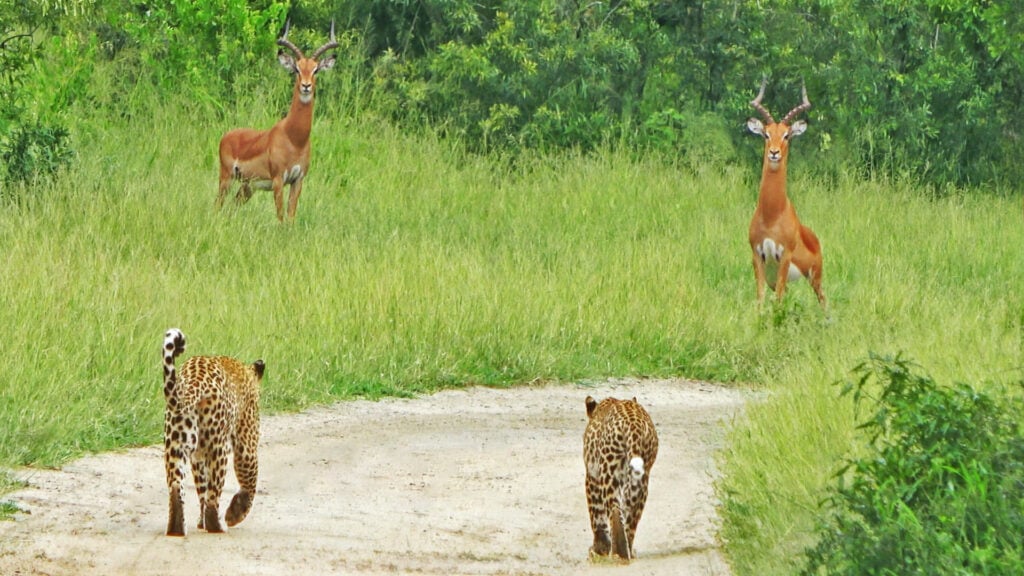

The pair of impala rams didn’t even flinch as the predators approached. So much hung in the balance, and yet they remained frozen to the spot.

Leopards approach impala pair
The leopards presented a fearsome pair, moving with characteristic stealth and majesty. They chose to walk along a sand road, following the road’s contours while the impala looked on.

Impala pair remain steadfast, inspite of leopard presence
However foolish it appears, this behaviour is actually completely normal, and is a well-known anti-predator response in impala when a leopard is nearby.
When impala suddenly freeze instead of fleeing, they are relying on stillness and camouflage. Leopards are ambush predators which depend heavily on stealth and surprise. Standing motionless reduces the impala’s movement so that the movement doesn’t trigger the leopard’s attack instinct. An impala which bolts too early may actually draw attention to itself and become the focus of the hunt.

Leopards walk alarmingly close to impala
The leopards drew closer to the impala, walked with their tails in the air behind them, with steady strides and a focused gaze.
Get our Best Sightings as they Come in

The impala stood to alert, still frozen but with their attention clearly fixated on the approaching leopards.

They moved slightly towards one another as the leopards came closer, keeping their heads fixed in the same position. Their magnificent horns and markings blending in with the bushveld terrain.

Impala flee, evading predator attack
As the leopards walked past, they turned to face the opposite direction, with the intent to flee. Then in a moment, they bolted off into the distance.
Game viewers must have held their breath as the impala narrowly escaped attack.
Impala are among the most successful antelope species in Africa, found in large numbers in the Kruger National Park. Their success comes from adaptability. Impala can switch easily between grazing on grass and browsing on leaves, depending on the season, allowing them to survive where more specialized antelope struggle.
They are extraordinary jumpers. An impala can leap up 3m high and over 10m in length in a single bound. These leaps aren’t just for speed. They’re also used to confuse predators by changing direction mid-air, making it difficult for lions, leopards, and cheetahs to predict their escape route.
Despite their slim appearance, impala are also incredibly fast. They can reach speeds of 80 to 90 km/h. However, what really saves them is agility rather than raw speed. Their ability to zigzag sharply at high speed gives them a major advantage over most predators.

An incredible moment of victory
The impalas’ successful flight was a moment of incredible victory and one that won’t easily be forgotten.
By standing still for so long and remaining calm and focused, they successfully evaded the leopards, which are apex predators and built for hunting and ambush.
This dramatic sighting showed the mastery of impala over their environment and their innate understanding of the behaviour of their bushveld opponents.
It’s moments such as these which leave viewers in awe of the wonders and intricacies of the bushveld.