












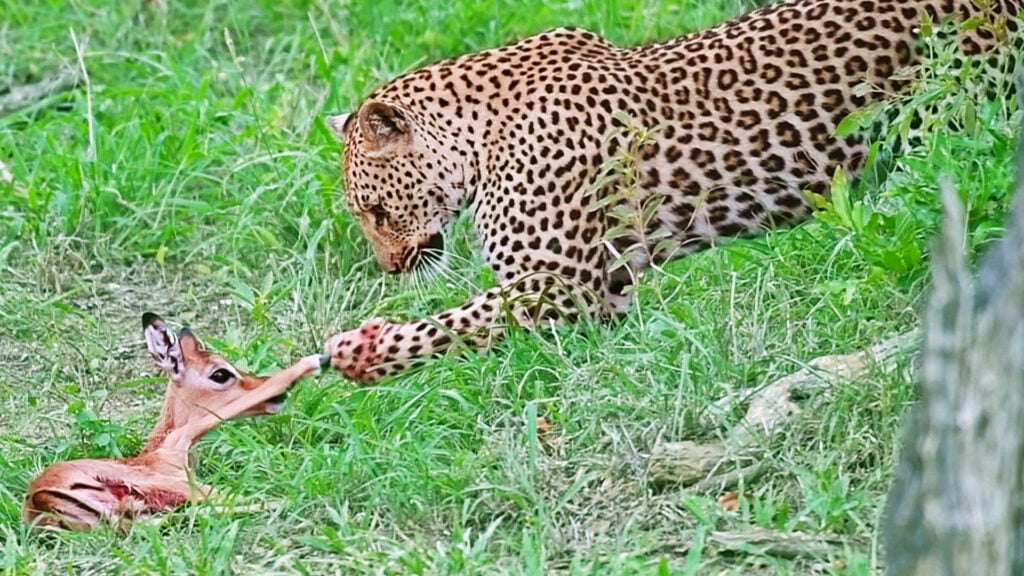

The leopard appeared to be trying to help the impala to stand. However, spectators feared for the impala’s safety. Afterall, a leopard doesn’t change its spots!

Leopard finds injured impala in the grass
Nachi Mirkin recalls the incredible moment: “I stumbled upon a young leopard which seemed very interested in something that was lying in the long grass.”
He says when looking closer, he realised the leopard was fixated on an injured impala. “It was a young newborn impala lamb.”
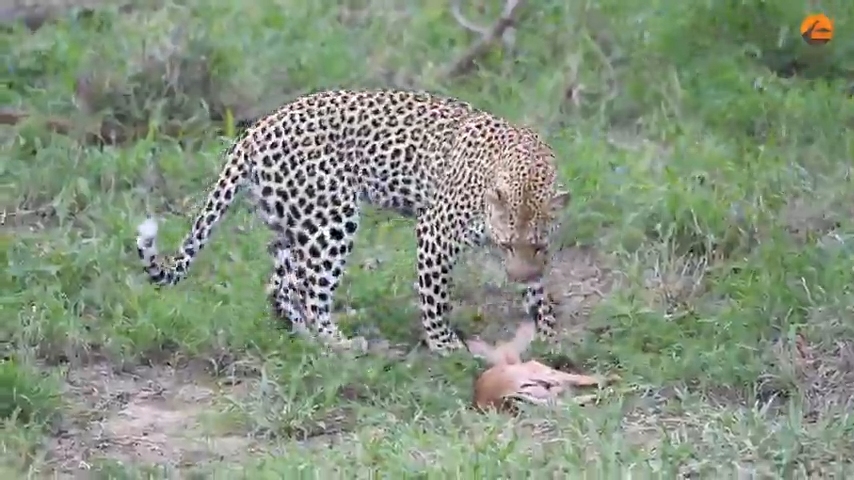
Leopard appears to reach out to injured impala
Nachi explains that what he witnessed next was both heartwarming and heartbreaking.
“The young leopard was fascinated by the newborn lamb,” he says.
The leopard prodded and nudged the small impala as though it were trying to help it to its feet.
As a wildlife photographer, Nachi has extensive knowledge on the wild: “Impala lambs are a common sight in the African savannah during the rainy season,” he says.
Get our Best Sightings as they Come in

“Female impalas give birth to their young after a gestation period of six to seven months. These lambs are born with an incredible instinct to survive, and they can stand and walk within minutes of being born.”
This young impala was injured and dazed, and its mother was nowhere in sight. It had no means of defending itself.
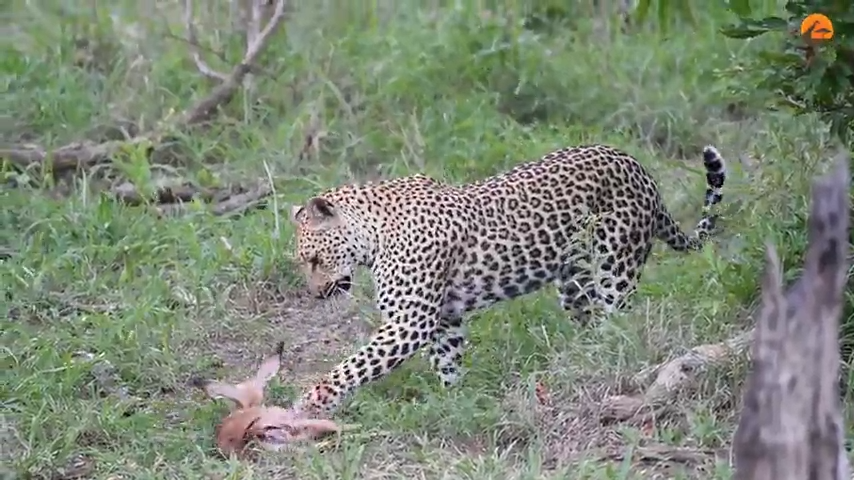
Without its mother nearby, and a leopard breathing over it, the small antelope was in a desperate situation.
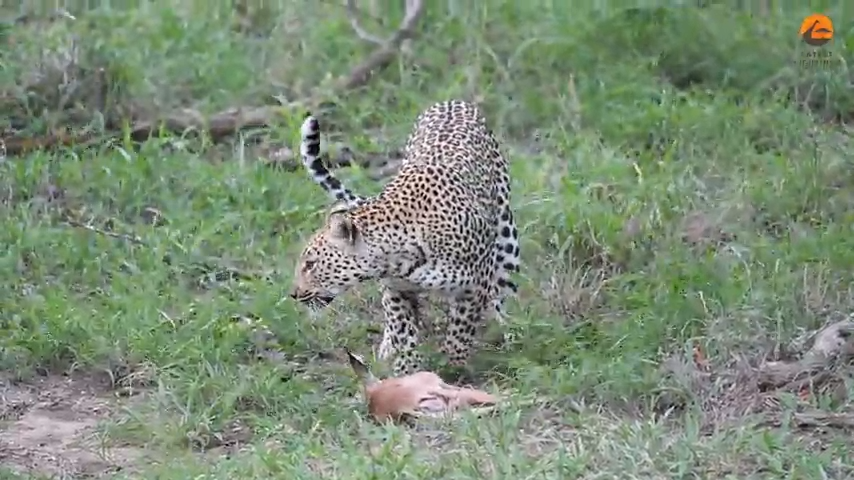
Nachi says he originally thought that the leopard was just trying to play with the lamb. However, he says that as he watched, it became evident that the leopard was just inexperienced and didn’t know how to kill and eat the small animal.
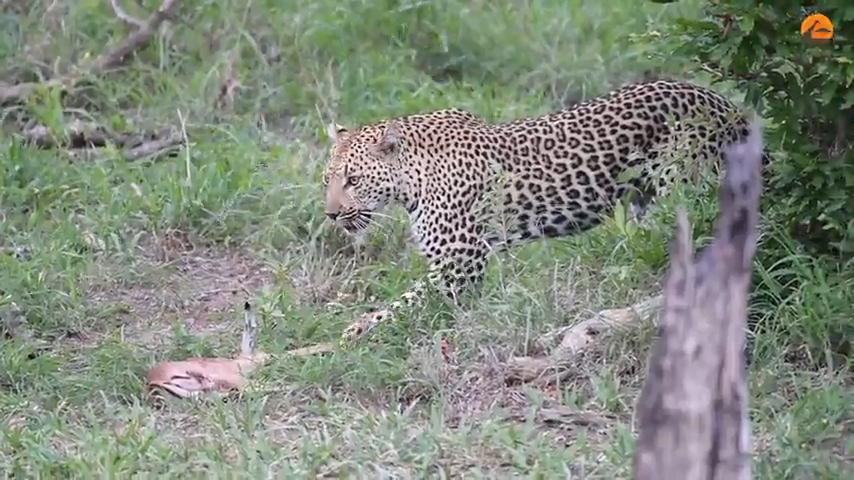
Leopard continues to ‘play’ with prospective food
The leopard continued to use his paw to try and move the lamb around, but the little lamb was so shocked that it did not move.
Impala lambs are highly vulnerable to predators like lions, hyenas, and leopards. It is estimated that up to 50 percent of impala lambs do not survive their first year.
Young leopards face a similar challenge in their early years. While they may have the instinct to hunt and kill, it takes years of practice and experience to perfect their skills.
Inexperienced young leopards often struggle to hunt and feed themselves, and they are forced to scavenge or steal from other predators.

Sensational moment highlights vulnerability of both species.
Says Nachi: “The interaction was one that highlighted the vulnerability of both species and the challenges they face in their early years. While moments like this can be heartbreaking, they serve as a true reflection of nature and the systems it has.”
In the wild, animals must do what they have to to survive and this can be heartbreaking to witness.
The leopard’s ultimate intent is predation, not compassion. Even hesitant interactions generally end in a kill unless the prey escapes or the leopard abandons it.
Instances which appear ‘gentle’ are often just moments where the leopard’s predatory drive is still developing or being measured against risk.