












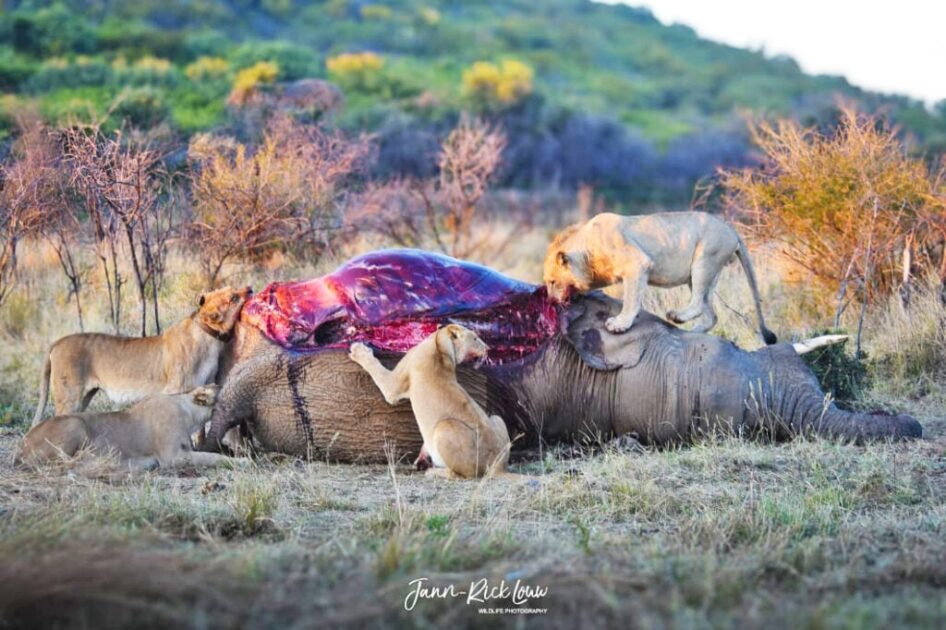

The region near the Manyane Gate set the stage for this dramatic action. Jann-Rick Louw captured it all on camera for Tsukudu Bush Lodge.
The elephant had been killed by another elephant and so when these lions arrived, they could hardly believe their luck. There waiting for them was a free meal!
The pride decided to climb on top of the elephant and put on a show of a lifetime!
Elephant’s death highlights complex herd interactions
As socially aware as elephants are, male elephants (bulls) usually establish dominance through sparring and fights. Older, stronger bulls often assert authority over younger males.
A young bull entering musth (a period of heightened testosterone and aggression) might challenge a dominant male, leading to serious confrontations.
In this instance, the young bull was possibly not strong enough and was severely injured as a result.
Elephant carcass attracts meat eaters
The herd had long since walked away from the deceased elephant by the time the pride of lions arrived for a free meal. Lions have a highly developed sense of smell and can detect the scent of decaying flesh from several kilometres away. As a carcass begins to decompose, it releases strong-smelling gases like putrescine and cadaverine, which are unmistakable to scavengers and carnivores. These gases alert predators and scavengers that there’s a dead animal nearby.
This unmistakable scent would have attracted them to where the elephant lay.
Lions do not typically hunt healthy adult elephants due to their size and strength. Most elephant carcasses they feed on are the result of natural death, or injury.
When they do come across one, it provides an enormous and long-lasting food source.
Get our Best Sightings as they Come in

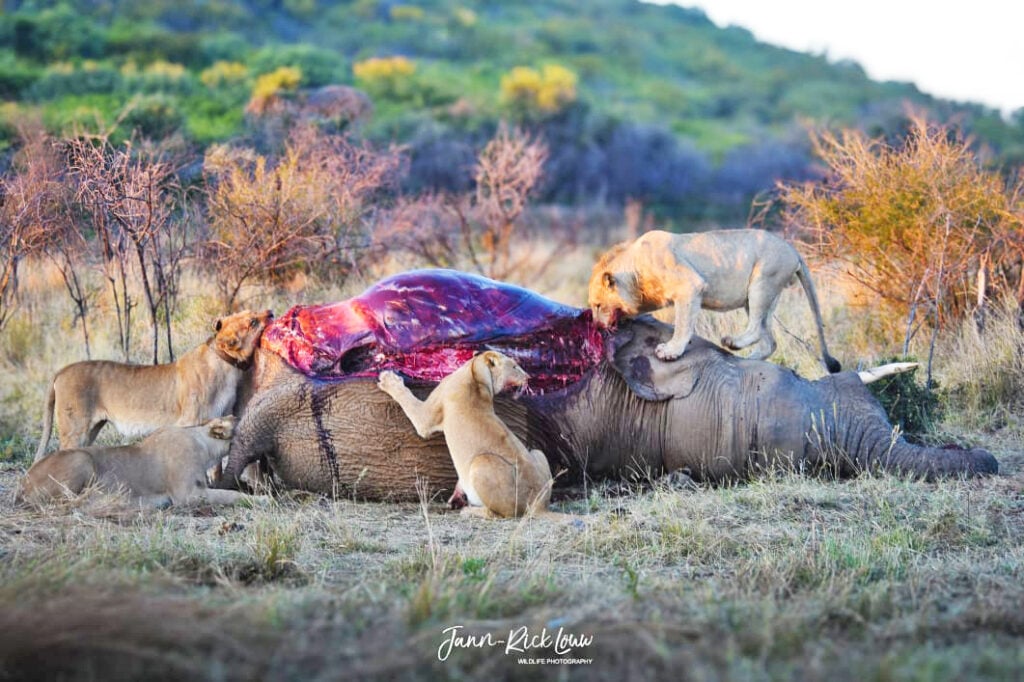
An elephant carcass can weigh a lot! That of a young bull such as this one can weigh anything in the region of 1 500kg to 3 000kg. The carcass was so large, the lions were even able to stand on top of it.
The carcass offered enough meat and fat to sustain the pride for many days.
Typically, when lions come across such a large feast, they will gorge themselves, before resting nearby. They will then return repeatedly to feed. The carcass will then become a central activity in their territory during that time.
Elephant meat provides both essential protein and also large reserves of fat, especially from organs and the marrow. This can improve the health and strength of pride members, especially cubs or undernourished individuals.
Potential risk from elephants
From the appearance of the carcass, it seems the death had been fairly recent. When this is the case, other elephants might remain in the area, mourning or protecting the body.
This could pose a threat to the lions.
However, the lions continued to feed without concern. The carcass was indeed a find for them. It gave them the opportunity to be sustained and strengthened, without having to go through the exertion of a hunt. They tucked in whole-heartedly, and approached the situation as they would have a hunt… that is, as a pride.