
Visitor Daniela Talamantes submitted this video to Latest Sightings. She filmed it on the S29, in the southeastern Kruger National Park, South Africa.
Dead impala
Daniela was on a game drive when she noticed something lying on the ground. On closer inspection, she realised it was a dead impala ram.
Unfortunately, there was no sign of any predators, so how the antelope died is a mystery.
Zoomed in
As she zoomed in, she realised that an animal was near the carcass. Its distinctive black and white coat gave it away as a honey badger.
Delighted with her discovery, Daniela began filming. To her surprise, she realised that the badger was feeding on the impala.
It is rare enough to see a wild honey badger. So, to see one actively scavenging was extra special for Daniela.
Feeding badger.
Subsequently, as she watched, she saw that the badger seemed to be chewing on the back of the impala’s neck. From time to time, the badger lifts the ram’s neck and head in its powerful jaws.
In case you’re wondering, it is entirely feasible that the badger killed the antelope. However, since no one saw the incident, we can only speculate.
Honey badger diet
Honey badgers are omnivores, eating a mixture of fruits, honey, insects, rodents, reptiles, and small to medium-sized mammals.
As regards impalas, they normally attack juvenile or injured specimens.
Short-sighted and short-tempered
Every so often, the honey badger would stop feeding and look towards Daniela and the other visitors who were enjoying the sighting.
Honey badgers have relatively poor eyesight, so it was probably trying to pinpoint the source of their voices. That said, the noise is unlikely to frighten the badger off.
Honey badgers are renowned for their fearlessness. They have been known to defend themselves against any creature that dares mess with them. This includes leopards, lions, hyenas, and even elephants.
Side-view
After feeding on the neck for a while, it seems the badger decided to look for a fleshier part of the impala to feast on. As it moved, it presented its side profile, showing off its distinctive high-contrast markings.
As is often the case with animals you shouldn’t mess with, these markings serve as a warning to other creatures not to approach.
Get our Best Sightings as they Come in
To defend themselves further, badgers may secrete a noxious chemical. Should this fail as a deterrent, they have sharp teeth, powerful jaws, and long claws with which to defend themselves.
Lastly, they have a thick, loose skin covering a squat, muscular body. Even if bitten or pinned down, they can still manoeuvre, enabling them to retaliate against the odds.
Nutrient-rich organs
As the video draws to an end, it looks like the badger is trying to rip open the antelope’s belly.
In doing so, it will be able to get to the highly nutritious organs.
More about honey badgers
Honey badgers are found across sub-Saharan Africa and southwestern Asia. They can be found in a wide range of habitats, from deserts to forests. Although seldom seen, they are common and active both day and night.
Hyperactive Baby Hippo Scares Everyone In The Waterhole
This amusing video was sent to Latest Sightings by Isa Carter. She filmed it at a water hole in South Africa’s Kruger National Park.
I’m bored!
It’s often said that an “only child” can be a challenge, especially for friends and neighbours. And, judging by the events in this video, the same is true in the animal kingdom.
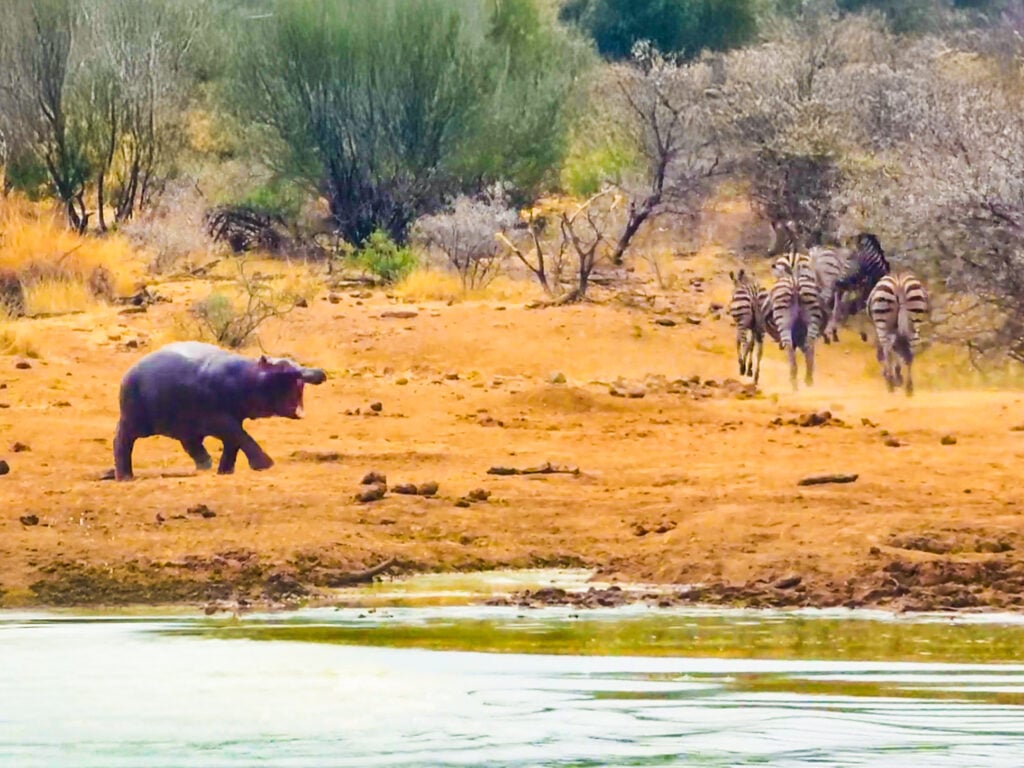
As Isa’s video begins, we see a lone hippo calf standing on the banks of its water hole. In the background, a herd of zebras await their turn to come down for a drink.
Amusing itself
It would seem that it has no one to socialise with. Nevertheless, as it runs around, it appears quite content to burn off the excess energy of youth on it’s own.
After charging around on the water’s edge for a while, it decides to return to the water, seemingly delighted at the big splash it makes.
For a chubby calf, it is surprisingly light-footed. As it takes to the water, it continues to amuse Isa and her companions with its antics. Quite what the rest of the onlookers think is open to debate.
Its mother, seen in the foreground above, seems content to watch the calf at play. Like any harried mum, she is probably enjoying a moment alone.
Thirsty zebras
Meanwhile, when the rambunctious calf took to the water, the zebras headed down to the water to slake their thirst. However, when the calf notices them, it cocks its ears in interest.
Potential playmates?
Consequently, it would seem that the calf saw the new arrivals as potential playmates. Subsequently, the over-enthusiastic calf set off towards the zebras with all the joys of youth.
Unfortunately for the little hippo, his barrelling approach was a bit much for the skittish zebras. In response, they turned and trotted away from the water’s edge.
By the time he emerged from the water, the zebras had retreated to the nearby treeline. Evidently, the hippos’ behaviour was a bit much when all they wanted was a quiet drink.
Get our Best Sightings as they Come in
Abundant energy
Nonetheless, their disappearance did little to dampen the calf’s enthusiasm. He had energy to spare and was going to burn it off one way or the other. Even if it meant playing with elephant dung…
As Isa’s video draws to an end, the little hippo, undeterred, continued to charge up and down on the lakeshore.
And, despite his protestations of innocent fun, the zebras in the background remained unwilling to join in the fun.
Playful practice
As amusing as the young hippo’s behaviour is, it actually serves an important part of its early development. Playtime for young animals is the time when they will learn the various skills necessary for long-term survival.
Hippos are highly territorial creatures, particularly in their aquatic homes. As such, while the calf may not be doing so intentionally, it is employing various behaviours that in later life will help it assert its territorial dominance.
These include charging towards intruders, patrolling the domain, and gaping jaw displays. Of course, at this stage in its life, it is all in the spirit of play.
However, later in life, these skills may mean the difference between life and death. Whatever the outcome, for us as observers, they’re both fascinating and fun to observe.
Be the first to comment on this article!