
Regular contributor Johan van Zyl submitted this video to Latest Sightings. He filmed the interesting behaviour in Kenya’s Masai Mara National Reserve.
Dangerous zebra crossing
During the Great Wildebeest Migration of East Africa, great herds of wildebeest, zebra and other antelopes must cross flooded rivers. Lying in wait are hundreds of crocodiles, eager to make the most of this seasonal abundance of prey.
Johan and his companions were watching one such croc feeding on a zebra when something strange happened. Two hippos, thought to be juveniles, approached to investigate, and Johan started filming.
In the image above, we see that the hippo in the foreground is approaching the feeding crocodile. While the two species share the water, an uneasy truce exists between them.
Croc sent packing
To our surprise, the young hippo then opens its mouth and bites the croc on the hind leg.
Considering that hippos have one of the strongest bite forces in the animal kingdom, this is no small thing. Immediately, the crocodile thrashes to escape the hippo’s unprovoked attack.
If you look closely at the hippo’s teeth in the image above, you’ll notice that it lacks the large canines of an adult hippo.
Meat-eating hippo?
As the croc moves away, we notice something else that’s unusual going on. The second hippo appears to be chewing on the zebra carcass.
As the hippo chews on the carcass, blood leaks into the water, suggesting that the hippo is in fact feeding.
While hippos primarily eat plants, researchers have well-documented this behaviour. They call it “facultative carnivory” and believe it occurs due to nutrient deficiencies, dietary stress, or the chance discovery of a carcass.
Hippo digestive systems process plant matter well, but their efficiency in dealing with meat is unknown. So it is unclear whether they actually derive much benefit from the practice.
Another bite at the prize
A short while later, the croc returned, hoping to resume feeding.
And once again, the nearer hippo advanced to drive it off. In this instance, the behaviour seems to be one motivated by territoriality.
Hippos are, by nature, extremely territorial, showing little tolerance for other species that venture too close. Reinforcing the case, the hippo forces away another crocodile that arrives to feed.
Dinner for two
Get our Best Sightings as they Come in
It is only when this crocodile moves away that the second hippo begins to show an interest in the carcass.
Around this time, we hear Johan saying that the hippo is just biting, and not necessarily eating the zebra flesh. As the muddy water obscures our view, it is hard to tell what is actually happening beneath the surface.
Hippo teeth are not designed to feed on flesh. However, we can assume that small pieces of flesh are being dislodged and swallowed in the process of chewing on the carcass.
Typical hippo diet
As mentioned, hippos are herbivores. Their typical diet consists of grass, occasionally supplemented with fruits, leaves and water plants.
To avoid the harsh effects of the sun on their sensitive skin, hippos do most of their feeding at night.
Hyperactive Baby Hippo Scares Everyone In The Waterhole
This amusing video was sent to Latest Sightings by Isa Carter. She filmed it at a water hole in South Africa’s Kruger National Park.
I’m bored!
It’s often said that an “only child” can be a challenge, especially for friends and neighbours. And, judging by the events in this video, the same is true in the animal kingdom.
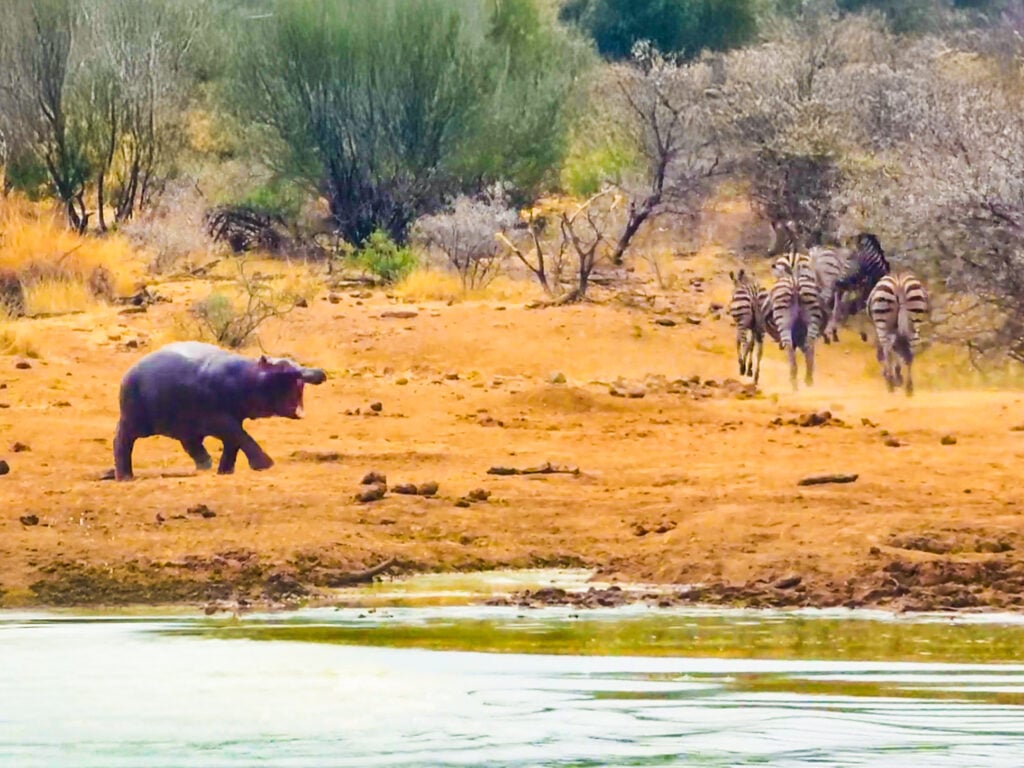
As Isa’s video begins, we see a lone hippo calf standing on the banks of its water hole. In the background, a herd of zebras await their turn to come down for a drink.
Amusing itself
It would seem that it has no one to socialise with. Nevertheless, as it runs around, it appears quite content to burn off the excess energy of youth on it’s own.
After charging around on the water’s edge for a while, it decides to return to the water, seemingly delighted at the big splash it makes.
For a chubby calf, it is surprisingly light-footed. As it takes to the water, it continues to amuse Isa and her companions with its antics. Quite what the rest of the onlookers think is open to debate.
Its mother, seen in the foreground above, seems content to watch the calf at play. Like any harried mum, she is probably enjoying a moment alone.
Thirsty zebras
Meanwhile, when the rambunctious calf took to the water, the zebras headed down to the water to slake their thirst. However, when the calf notices them, it cocks its ears in interest.
Potential playmates?
Consequently, it would seem that the calf saw the new arrivals as potential playmates. Subsequently, the over-enthusiastic calf set off towards the zebras with all the joys of youth.
Unfortunately for the little hippo, his barrelling approach was a bit much for the skittish zebras. In response, they turned and trotted away from the water’s edge.
By the time he emerged from the water, the zebras had retreated to the nearby treeline. Evidently, the hippos’ behaviour was a bit much when all they wanted was a quiet drink.
Get our Best Sightings as they Come in
Abundant energy
Nonetheless, their disappearance did little to dampen the calf’s enthusiasm. He had energy to spare and was going to burn it off one way or the other. Even if it meant playing with elephant dung…
As Isa’s video draws to an end, the little hippo, undeterred, continued to charge up and down on the lakeshore.
And, despite his protestations of innocent fun, the zebras in the background remained unwilling to join in the fun.
Playful practice
As amusing as the young hippo’s behaviour is, it actually serves an important part of its early development. Playtime for young animals is the time when they will learn the various skills necessary for long-term survival.
Hippos are highly territorial creatures, particularly in their aquatic homes. As such, while the calf may not be doing so intentionally, it is employing various behaviours that in later life will help it assert its territorial dominance.
These include charging towards intruders, patrolling the domain, and gaping jaw displays. Of course, at this stage in its life, it is all in the spirit of play.
However, later in life, these skills may mean the difference between life and death. Whatever the outcome, for us as observers, they’re both fascinating and fun to observe.
Be the first to comment on this article!