
Regular contributor Mike Kirkman of MalaMala submitted this video to Latest Sightings. He filmed it in the Sabi Sands Game Reserve in South Africa.
Seldom seen antelope
Mike’s video begins with a fairly uncommon sighting in the Sabi Sands Game Reserve. A small herd of nyala antelope are making their way through the riparian forest on the bank of a river.
The nyala in shot is the female, who sports a beautiful russet-coloured coat with white vertical stripes. Males are quite different, with dark grey coats and elegant spiralled horns.
Predator detected
In the next scene, we see the nyala ewe on the alert. She has sensed, probably using her sharp nose, the presence of a predator.
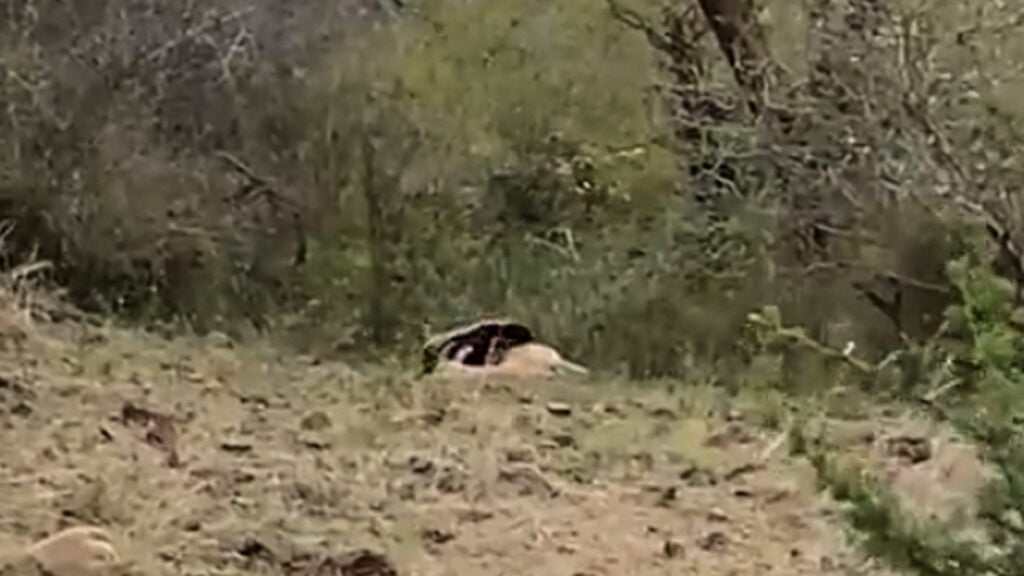
While she can’t yet see it, a female leopard is standing motionless in the bottom right corner of the above image. See if you can spot the distinctive black behind its ears.
Trust your instincts
Consequently, after barking out an alarm call, the ewe attempts to locate the leopard. Checking her surroundings thoroughly, she even glances into the trees above, hoping to spot the source of the scent filling her nostrils.
However, the leopard’s incredible rosetted coat proves its worth in helping keep its location hidden. Their markings serve to break up their outline, especially in thick bush and low light, rendering them all but invisible to prey.
A closer look
Subsequently, after not being able to find the leopard, the nyala moves forward, keenly sniffing the air in her efforts to locate her enemy. This is a risky move, particularly in the long grass where anything could be hiding out of view.
At this point, we hear other nyala alarm calls. This will result in heightened vigilance and reduce the leopard’s chances of a successful hunt.
Meanwhile, the leopard remains almost completely motionless; only the occasional flick of her tail indicates the nervous tension of the predator on the hunt.
Careful retreat
Then we hear Mike say that he thinks the nyala has spotted the leopard. Instead of bolting, the antelope daintily picks her way up the slope away from danger.
As the ewe moves away, we see the leopard tensing up. Her intended meal is getting further away, reducing her chances of catching it. She needs to make a decision, and fast.
Get our Best Sightings as they Come in
Ambush sprung
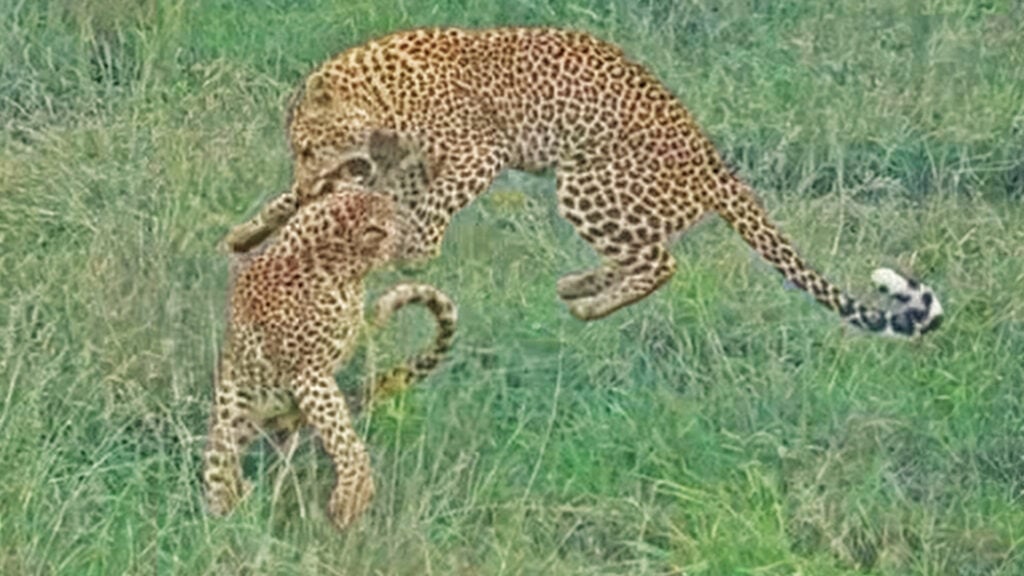
Sensing that she may have left her attack too late, the leopard takes a gamble and springs from cover. As she does, we see another nyala burst from cover.
It would appear that the second nyala was the leopard’s target all along. Nonetheless, she has left it far too late and the nyalas bound up the slope, easily outpacing the spotted predator.
On a side note: Do you see the white underside of the nyala’s tails? These are visual markers that allow others to follow, especially when fleeing danger. Numerous antelope species have a white underside to their tails, including kudu and impala.
Follow-me markers
As the nyala disappears from view, the leopard calls off her chase. Now we get a clear view of her tail tip, which is also white.
Only with leopards, the visual marker is to help cubs follow their mother when it is dark or visibility is otherwise limited.
Her plans thwarted, the leopard has no choice but to keep on searching for prey. In this area, they are successful in nearly four out of ten attempts. Better luck next time.
Hyperactive Baby Hippo Scares Everyone In The Waterhole
This amusing video was sent to Latest Sightings by Isa Carter. She filmed it at a water hole in South Africa’s Kruger National Park.
I’m bored!
It’s often said that an “only child” can be a challenge, especially for friends and neighbours. And, judging by the events in this video, the same is true in the animal kingdom.
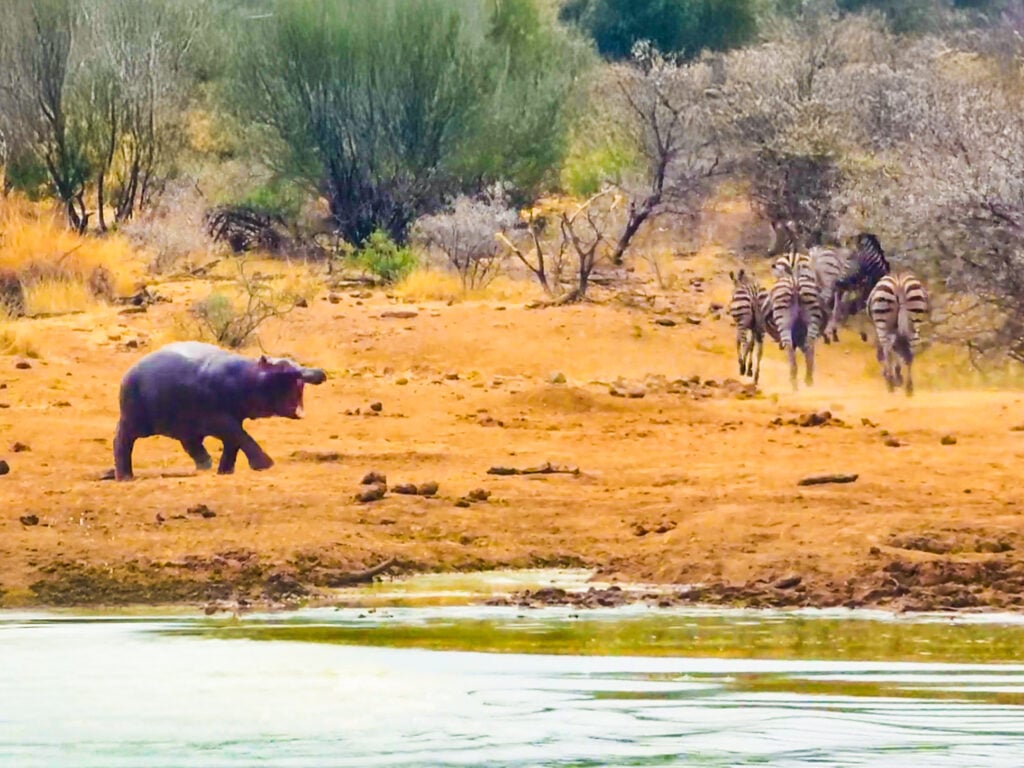
As Isa’s video begins, we see a lone hippo calf standing on the banks of its water hole. In the background, a herd of zebras await their turn to come down for a drink.
Amusing itself
It would seem that it has no one to socialise with. Nevertheless, as it runs around, it appears quite content to burn off the excess energy of youth on it’s own.
After charging around on the water’s edge for a while, it decides to return to the water, seemingly delighted at the big splash it makes.
For a chubby calf, it is surprisingly light-footed. As it takes to the water, it continues to amuse Isa and her companions with its antics. Quite what the rest of the onlookers think is open to debate.
Its mother, seen in the foreground above, seems content to watch the calf at play. Like any harried mum, she is probably enjoying a moment alone.
Thirsty zebras
Meanwhile, when the rambunctious calf took to the water, the zebras headed down to the water to slake their thirst. However, when the calf notices them, it cocks its ears in interest.
Potential playmates?
Consequently, it would seem that the calf saw the new arrivals as potential playmates. Subsequently, the over-enthusiastic calf set off towards the zebras with all the joys of youth.
Unfortunately for the little hippo, his barrelling approach was a bit much for the skittish zebras. In response, they turned and trotted away from the water’s edge.
By the time he emerged from the water, the zebras had retreated to the nearby treeline. Evidently, the hippos’ behaviour was a bit much when all they wanted was a quiet drink.
Get our Best Sightings as they Come in
Abundant energy
Nonetheless, their disappearance did little to dampen the calf’s enthusiasm. He had energy to spare and was going to burn it off one way or the other. Even if it meant playing with elephant dung…
As Isa’s video draws to an end, the little hippo, undeterred, continued to charge up and down on the lakeshore.
And, despite his protestations of innocent fun, the zebras in the background remained unwilling to join in the fun.
Playful practice
As amusing as the young hippo’s behaviour is, it actually serves an important part of its early development. Playtime for young animals is the time when they will learn the various skills necessary for long-term survival.
Hippos are highly territorial creatures, particularly in their aquatic homes. As such, while the calf may not be doing so intentionally, it is employing various behaviours that in later life will help it assert its territorial dominance.
These include charging towards intruders, patrolling the domain, and gaping jaw displays. Of course, at this stage in its life, it is all in the spirit of play.
However, later in life, these skills may mean the difference between life and death. Whatever the outcome, for us as observers, they’re both fascinating and fun to observe.
Be the first to comment on this article!