
Gayle Erasmus submitted the accompanying photos and video clips to Latest Sightings. She filmed it on the low-level bridge near Lower Sabie Camp, in South Africa’s Kruger National Park.
Down by the river
Gayle told Latest Sightings that she had parked on the bridge just south of Lower Sabie, one of her favourite spots in the park. She had seen many amazing things there previously and was enjoying the tranquillity, when a splash got her attention.
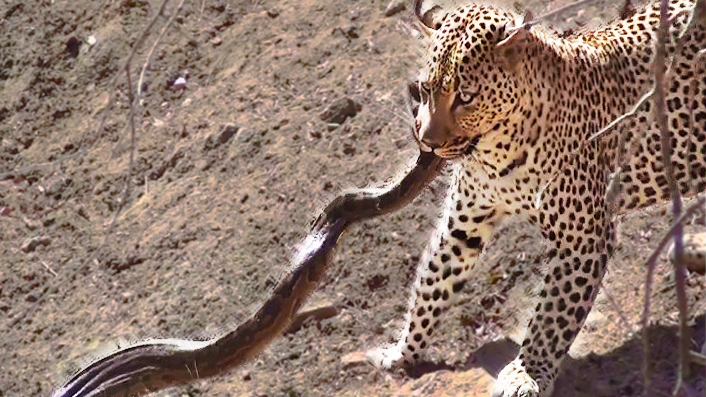
Gayle followed the commotion and discovered a small Nile crocodile had caught an African rock python.
She said, “We couldn’t tell if it was the moment it caught the python or if the python was already dead, but the sighting was far from over.”
Having evolved to hunt in their aquatic habitat over millions of years, crocodiles generally target fish, birds and mammals. However, should a fellow reptilian venture into their domain, they are equally at risk of capture.
Bite-size chunks
Although the crocodile had caught the snake easily, eating it proved to be a challenge.
Crocodiles swallow small prey like fish whole, but break larger prey into smaller pieces before eating.
However, snakes are generally long and flexible by nature. This means that they are difficult for crocodiles to deal with.
Crocodile teeth grip and rip by design. Despite their crushing bite force, they’re not terribly efficient at cutting through snakes.
Not so simple to snap a snake
As a result, when the croc tried to sever the snake’s body, it had to perform a series of energetic movements.
But, no matter how much it thrashed about, the croc struggled to make any headway. The more it thrashed, the more the snake’s flexible body flopped about.
Getting a head
Eventually, the croc made some progress when it managed to remove the python’s head. After finally getting a taste, the croc still had its work cut out if it hoped to consume the rest.
Get our Best Sightings as they Come in
Shake, snap, repeat
This led to another round of wild thrashing. This time, holding the snake a bit further down its body, hoping to replicate its earlier success.
But, after swiping back and forth and left and right, all the crocodile succeeded in doing was to tire itself out. Consequently, it had to take a break.
Time and again, the frustrated croc would pick up the limp snake and attempt to tear it into smaller pieces. And, time and again, it failed to do so.
Gayle concluded her story by telling Latest Sightings, “The crocodile eventually moved into deeper water, concealed by reeds, and we lost sight of it. It was a mesmerising and truly unique sighting that left us in awe.”
Mega reptiles
When fully grown, the two reptiles featured in this article rank among the largest on the African continent.
Nile crocodiles can reach lengths of up to 6 metres (20 feet) and can weigh up to 1000 kilograms (2200 lbs).
Southern African rock pythons grow up to 4.6 m (15 ft), weighing up to 53.4 kg (118 lb).
While crocodiles probably account for more human fatalities than any other predator in Africa, few, if any, are killed, let alone injured by pythons.
Hyperactive Baby Hippo Scares Everyone In The Waterhole
This amusing video was sent to Latest Sightings by Isa Carter. She filmed it at a water hole in South Africa’s Kruger National Park.
I’m bored!
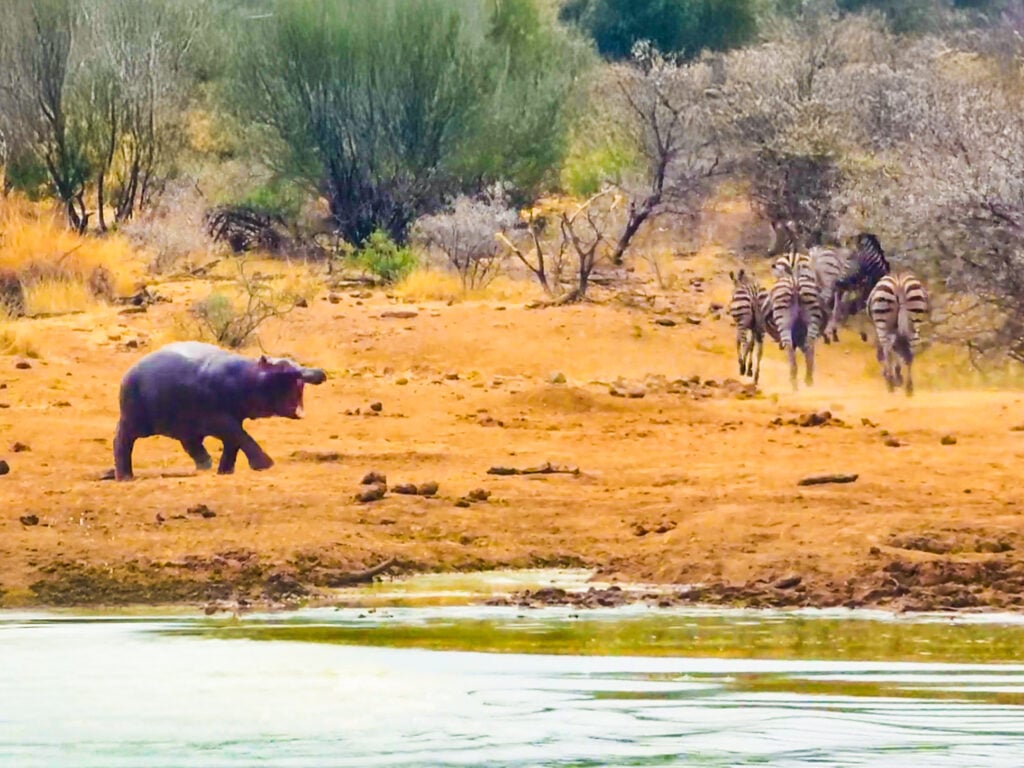
It’s often said that an “only child” can be a challenge, especially for friends and neighbours. And, judging by the events in this video, the same is true in the animal kingdom.
As Isa’s video begins, we see a lone hippo calf standing on the banks of its water hole. In the background, a herd of zebras await their turn to come down for a drink.
Amusing itself
It would seem that it has no one to socialise with. Nevertheless, as it runs around, it appears quite content to burn off the excess energy of youth on it’s own.
After charging around on the water’s edge for a while, it decides to return to the water, seemingly delighted at the big splash it makes.
For a chubby calf, it is surprisingly light-footed. As it takes to the water, it continues to amuse Isa and her companions with its antics. Quite what the rest of the onlookers think is open to debate.
Its mother, seen in the foreground above, seems content to watch the calf at play. Like any harried mum, she is probably enjoying a moment alone.
Thirsty zebras
Meanwhile, when the rambunctious calf took to the water, the zebras headed down to the water to slake their thirst. However, when the calf notices them, it cocks its ears in interest.
Potential playmates?
Consequently, it would seem that the calf saw the new arrivals as potential playmates. Subsequently, the over-enthusiastic calf set off towards the zebras with all the joys of youth.
Unfortunately for the little hippo, his barrelling approach was a bit much for the skittish zebras. In response, they turned and trotted away from the water’s edge.
By the time he emerged from the water, the zebras had retreated to the nearby treeline. Evidently, the hippos’ behaviour was a bit much when all they wanted was a quiet drink.
Get our Best Sightings as they Come in
Abundant energy
Nonetheless, their disappearance did little to dampen the calf’s enthusiasm. He had energy to spare and was going to burn it off one way or the other. Even if it meant playing with elephant dung…
As Isa’s video draws to an end, the little hippo, undeterred, continued to charge up and down on the lakeshore.
And, despite his protestations of innocent fun, the zebras in the background remained unwilling to join in the fun.
Playful practice
As amusing as the young hippo’s behaviour is, it actually serves an important part of its early development. Playtime for young animals is the time when they will learn the various skills necessary for long-term survival.
Hippos are highly territorial creatures, particularly in their aquatic homes. As such, while the calf may not be doing so intentionally, it is employing various behaviours that in later life will help it assert its territorial dominance.
These include charging towards intruders, patrolling the domain, and gaping jaw displays. Of course, at this stage in its life, it is all in the spirit of play.
However, later in life, these skills may mean the difference between life and death. Whatever the outcome, for us as observers, they’re both fascinating and fun to observe.
Be the first to comment on this article!