
Erin Simon submitted this unusual video to Latest Sightings. She filmed it on the H-7, between Satara and Orpen Camps, in the Kruger National Park, South Africa.
Buffalo sighting
Cape buffalo are a member of the Big 5, renowned for their large herds and occasionally grumpy temperament. While on a game drive, Erin and her companions were happy to find a large herd.
However, as they watched, something unusual caught Erin’s eye. After taking a look with her binoculars, she realised they had stumbled across something very unusual.
So, she picked up her camera and began filming, perhaps thinking no one would believe her if she didn’t.
Something’s not quite right
As we join the action in her video, we see a few buffalo walking through the long, dry grass. However, on closer inspection, we realise that something is not quite right.
In their midst, we see a flash of white. This is a colour that seldom occurs naturally in the African bush, in part because it stands out so clearly.
Obscured by the larger body of one of the cows, we see it is an animal of some sort, but it takes a few moments before we get a clear view.
Eventually, we see the head. Aside from its colour, it is unmistakable as a buffalo calf, probably just a few days old.
Albino?
Most people assume this must be a rare albino, similar to the white lions occasionally spotted in this part of Kruger Park.
However, it is something a little less rare. The calf has a condition known as leucism.
In albinism, pigmentation lightens the entire body, while in leucism, some body parts retain their normal colour.
Zooming in on this calf, we can just see that the skin of its nose is dark. And it appears that its eye is also brown, whereas it would be pale were it a true albino.
Get our Best Sightings as they Come in
Singled out for its colour
As the calf follows its mother closely, it stands out against the tan background. While buffalo don’t necessarily rely on camouflage to avoid predators, this calf’s colour would undoubtedly make it a prime target, particularly at night.
One of the key differences between albinism and leucism is that as the animal ages, its colour gets progressively darker.
However, at the best of times, only 50% of buffalo calves survive past their first year, so this calf’s chances of survival are probably not good.
Problems closer to home
Besides the risk of being singled out by a predator, they are also frequently not accepted by their own kind. And this may be why one of its herd members butts it out of the way at one point.
Thankfully, the calf doesn’t appear to be injured and quickly regains its feet as its mother turns to check on it.
As the herd moves on, the calf soon disappears among the larger bodies of the adults.
Provided it is fully accepted by all members of the herd, their protection might prove to be its saving grace.
Hyperactive Baby Hippo Scares Everyone In The Waterhole
This amusing video was sent to Latest Sightings by Isa Carter. She filmed it at a water hole in South Africa’s Kruger National Park.
I’m bored!
It’s often said that an “only child” can be a challenge, especially for friends and neighbours. And, judging by the events in this video, the same is true in the animal kingdom.
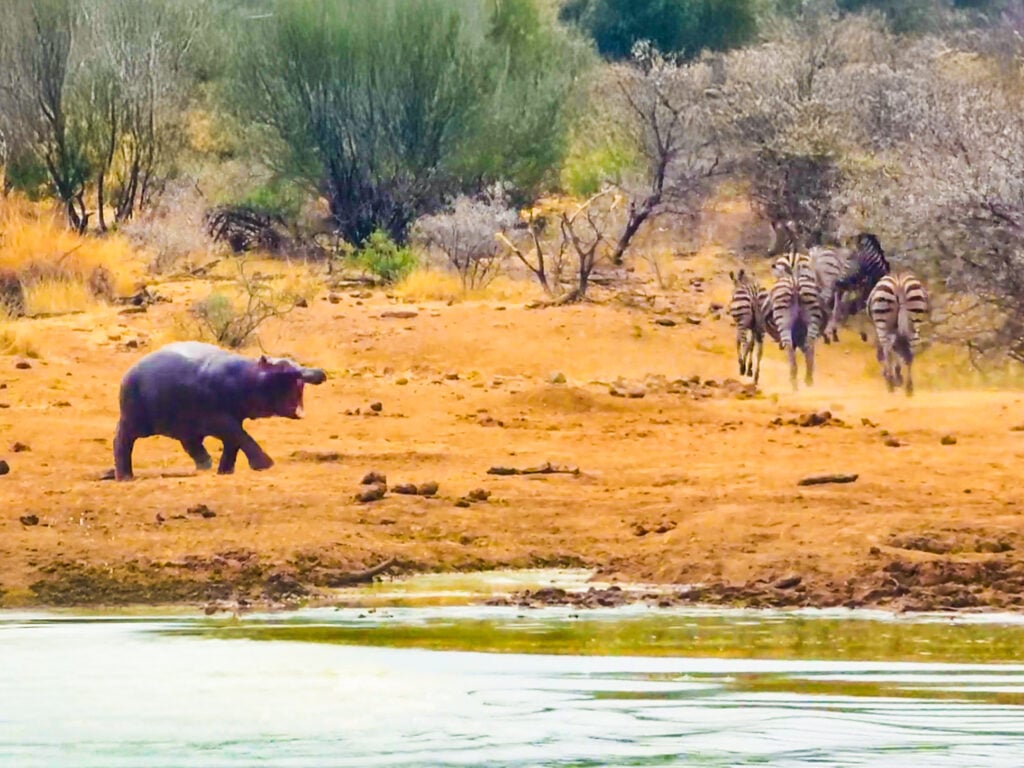
As Isa’s video begins, we see a lone hippo calf standing on the banks of its water hole. In the background, a herd of zebras await their turn to come down for a drink.
Amusing itself
It would seem that it has no one to socialise with. Nevertheless, as it runs around, it appears quite content to burn off the excess energy of youth on it’s own.
After charging around on the water’s edge for a while, it decides to return to the water, seemingly delighted at the big splash it makes.
For a chubby calf, it is surprisingly light-footed. As it takes to the water, it continues to amuse Isa and her companions with its antics. Quite what the rest of the onlookers think is open to debate.
Its mother, seen in the foreground above, seems content to watch the calf at play. Like any harried mum, she is probably enjoying a moment alone.
Thirsty zebras
Meanwhile, when the rambunctious calf took to the water, the zebras headed down to the water to slake their thirst. However, when the calf notices them, it cocks its ears in interest.
Potential playmates?
Consequently, it would seem that the calf saw the new arrivals as potential playmates. Subsequently, the over-enthusiastic calf set off towards the zebras with all the joys of youth.
Unfortunately for the little hippo, his barrelling approach was a bit much for the skittish zebras. In response, they turned and trotted away from the water’s edge.
By the time he emerged from the water, the zebras had retreated to the nearby treeline. Evidently, the hippos’ behaviour was a bit much when all they wanted was a quiet drink.
Get our Best Sightings as they Come in
Abundant energy
Nonetheless, their disappearance did little to dampen the calf’s enthusiasm. He had energy to spare and was going to burn it off one way or the other. Even if it meant playing with elephant dung…
As Isa’s video draws to an end, the little hippo, undeterred, continued to charge up and down on the lakeshore.
And, despite his protestations of innocent fun, the zebras in the background remained unwilling to join in the fun.
Playful practice
As amusing as the young hippo’s behaviour is, it actually serves an important part of its early development. Playtime for young animals is the time when they will learn the various skills necessary for long-term survival.
Hippos are highly territorial creatures, particularly in their aquatic homes. As such, while the calf may not be doing so intentionally, it is employing various behaviours that in later life will help it assert its territorial dominance.
These include charging towards intruders, patrolling the domain, and gaping jaw displays. Of course, at this stage in its life, it is all in the spirit of play.
However, later in life, these skills may mean the difference between life and death. Whatever the outcome, for us as observers, they’re both fascinating and fun to observe.
Be the first to comment on this article!