
Clayton Herb sent this interesting video to Latest Sightings. He filmed the incidents in South Africa’s Sabi Sand Game Reserve.
Sought-after leopards
For visitors to South Africa’s game parks, probably one of the most hoped-for sightings is leopards. However, not everyone is fortunate enough to see even a glimpse of these stealthy predators.
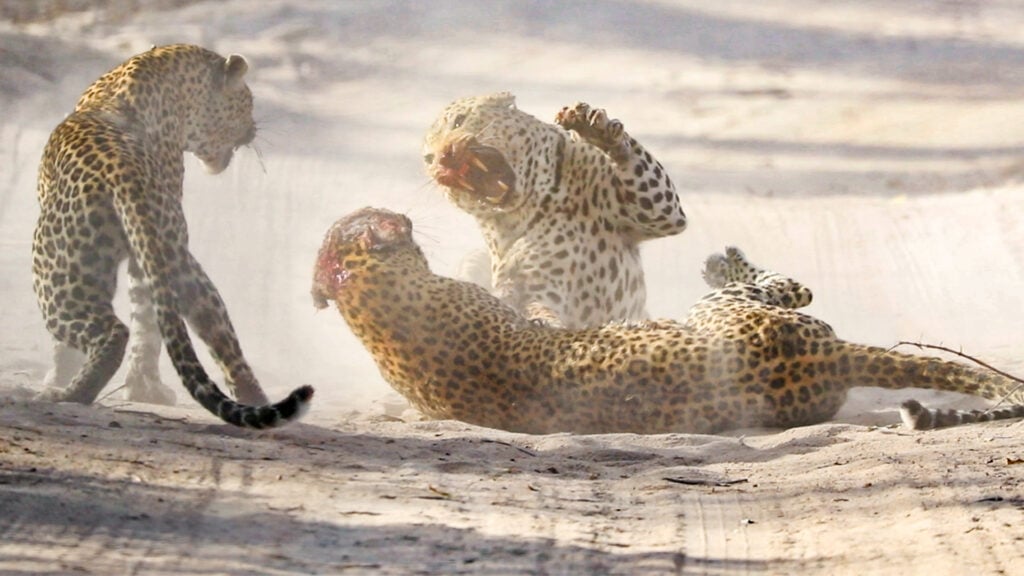
So, the tourists who witnessed the action in this video were very lucky. As we join the action, we see not one but two leopards moments after capturing an impala ram.
Mother and son
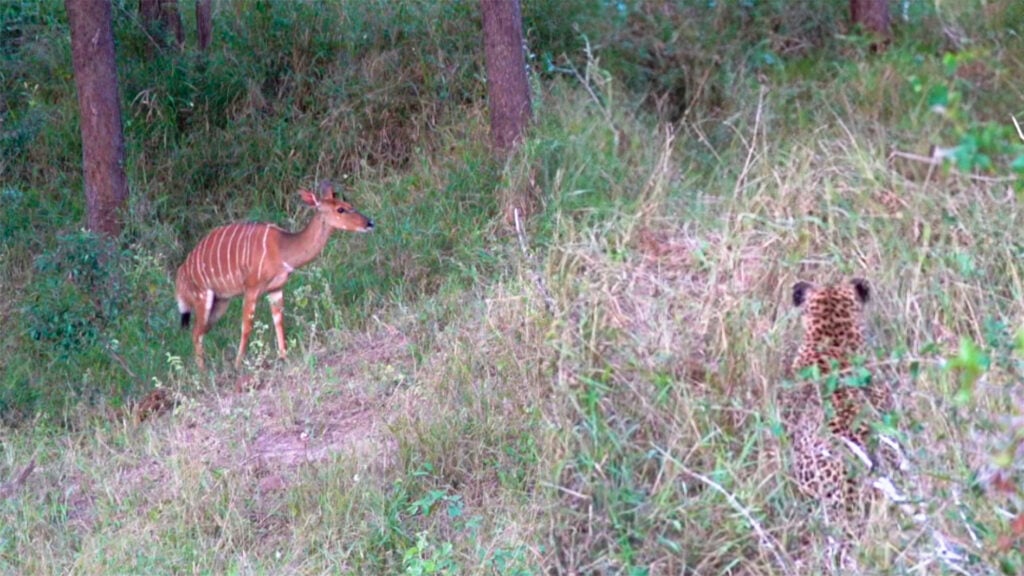
Unfortunately, we received no information about the leopards in the video. However, we think it is safe to assume that this is a mother leopard with her sub-adult male offspring.
Furthermore, it would appear that the mother leopard is using the opportunity to let her cub gain valuable hunting experience. This is because, while she holds onto the ram’s hindquarters, the slightly smaller male is left to go for its throat.
Going for the throat
Whether the male is acting on learned or instinctual behaviour is uncertain. However, when it manages to clamp its jaws on the ram’s throat, the action is classic leopard.
As solitary hunters, the one thing leopards want to avoid is attracting the attention of other predators. Should this happen, they might well lose their hard-earned prey.
So, by closing off their prey’s windpipes, they reduce the chances of it emitting an alarm call. In doing so, they begin the often drawn-out process of asphyxiation.
Slow process
Despite having its air supply effectively cut off, it is amazing to see the impala remain standing. Even the mother leopard seems bemused as she hangs onto its hindquarters.
On average, death by asphyxiation takes between 2 and 5 minutes, although the prey will likely lose consciousness within minutes.
Dinner delayed
When social predators hunt together, it often happens that while one attempts to asphyxiate the prey, other members of the group start feeding. However, in the case of these leopards, that doesn’t happen.
Could this be because they are typically solitary, and therefore not familiar with the behaviour?
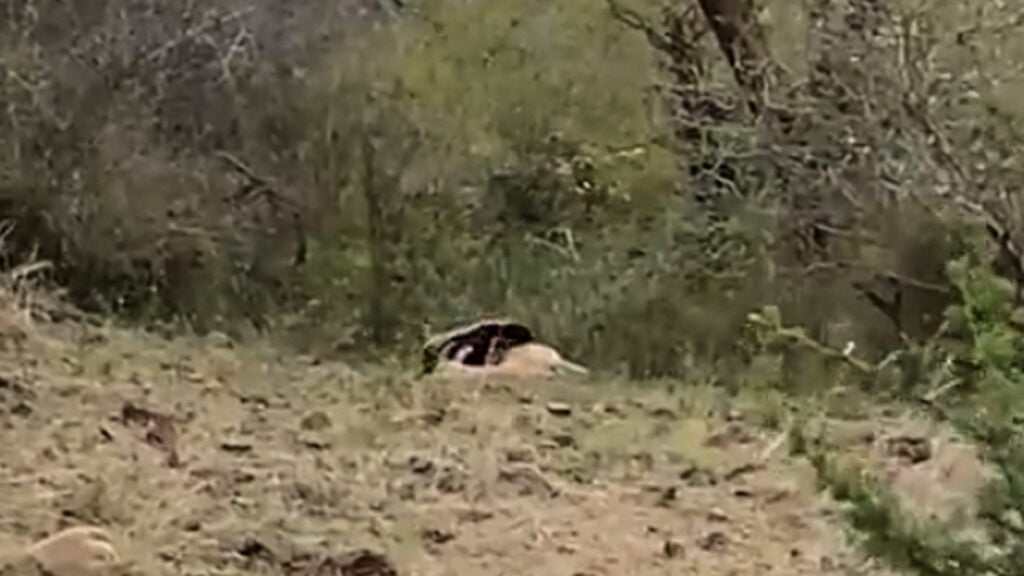
Or, is it that this particular impala is proving more difficult than usual to subdue? By the time the above image was captured, the impala’s throat had been clamped for nearly a minute.
Get our Best Sightings as they Come in
Another question often asked is whether the impala is suffering. There are no conclusive findings in this regard, except that mammals go into shock when severely injured.
There is a theory that this is not so much to prevent them from feeling pain, but to concentrate their energy on survival. If the pain were too great, they would not be able to do this due to the “distraction” of pain.
Outcome unknown
As the video comes to its conclusion, there are signs that the impala is losing strength. It is no longer able to hold its head upright and will probably collapse shortly.
Unfortunately, the video comes to an end before we find out whether or not the impala survived. Or, for that matter, whether the leopards got their hard-earned meal.
Hyperactive Baby Hippo Scares Everyone In The Waterhole
This amusing video was sent to Latest Sightings by Isa Carter. She filmed it at a water hole in South Africa’s Kruger National Park.
I’m bored!
It’s often said that an “only child” can be a challenge, especially for friends and neighbours. And, judging by the events in this video, the same is true in the animal kingdom.
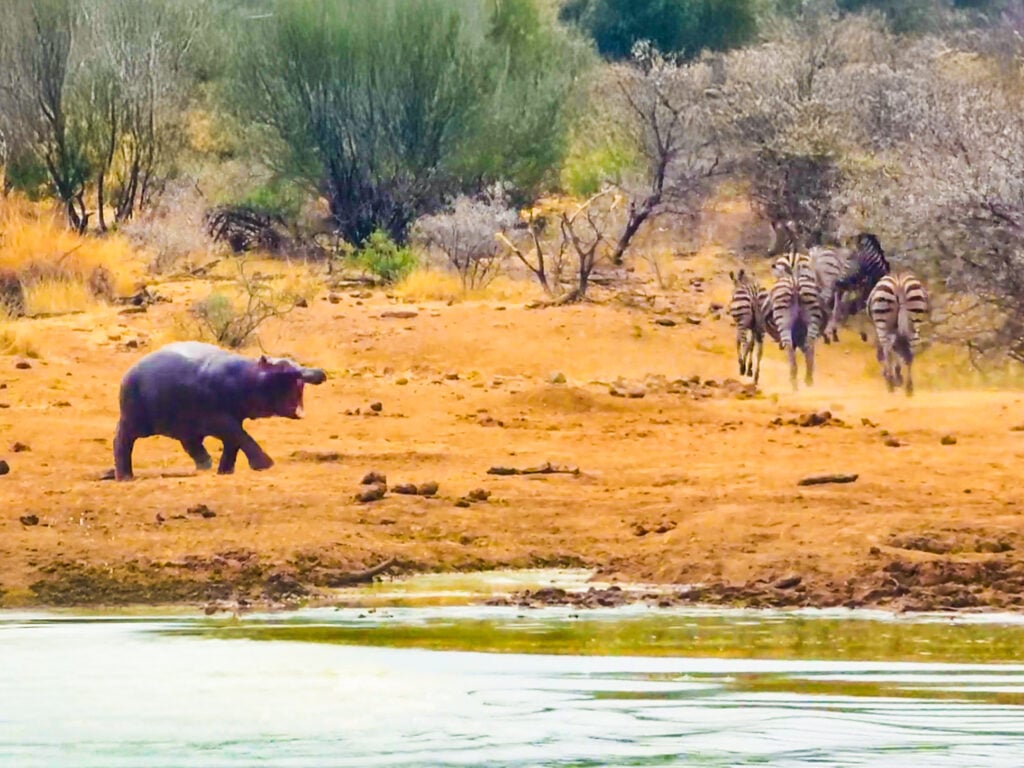
As Isa’s video begins, we see a lone hippo calf standing on the banks of its water hole. In the background, a herd of zebras await their turn to come down for a drink.
Amusing itself
It would seem that it has no one to socialise with. Nevertheless, as it runs around, it appears quite content to burn off the excess energy of youth on it’s own.
After charging around on the water’s edge for a while, it decides to return to the water, seemingly delighted at the big splash it makes.
For a chubby calf, it is surprisingly light-footed. As it takes to the water, it continues to amuse Isa and her companions with its antics. Quite what the rest of the onlookers think is open to debate.
Its mother, seen in the foreground above, seems content to watch the calf at play. Like any harried mum, she is probably enjoying a moment alone.
Thirsty zebras
Meanwhile, when the rambunctious calf took to the water, the zebras headed down to the water to slake their thirst. However, when the calf notices them, it cocks its ears in interest.
Potential playmates?
Consequently, it would seem that the calf saw the new arrivals as potential playmates. Subsequently, the over-enthusiastic calf set off towards the zebras with all the joys of youth.
Unfortunately for the little hippo, his barrelling approach was a bit much for the skittish zebras. In response, they turned and trotted away from the water’s edge.
By the time he emerged from the water, the zebras had retreated to the nearby treeline. Evidently, the hippos’ behaviour was a bit much when all they wanted was a quiet drink.
Get our Best Sightings as they Come in
Abundant energy
Nonetheless, their disappearance did little to dampen the calf’s enthusiasm. He had energy to spare and was going to burn it off one way or the other. Even if it meant playing with elephant dung…
As Isa’s video draws to an end, the little hippo, undeterred, continued to charge up and down on the lakeshore.
And, despite his protestations of innocent fun, the zebras in the background remained unwilling to join in the fun.
Playful practice
As amusing as the young hippo’s behaviour is, it actually serves an important part of its early development. Playtime for young animals is the time when they will learn the various skills necessary for long-term survival.
Hippos are highly territorial creatures, particularly in their aquatic homes. As such, while the calf may not be doing so intentionally, it is employing various behaviours that in later life will help it assert its territorial dominance.
These include charging towards intruders, patrolling the domain, and gaping jaw displays. Of course, at this stage in its life, it is all in the spirit of play.
However, later in life, these skills may mean the difference between life and death. Whatever the outcome, for us as observers, they’re both fascinating and fun to observe.
Be the first to comment on this article!