
Warick Wrede submitted this delightful short video to Latest Sightings. He filmed it while visiting Pilanesberg National Park in South Africa’s Northwest Province.
Sought-after sighting
Leopard sightings rank high on the wish list for most visitors to South Africa’s national parks. With their gorgeous spotted coats and enigmatic behaviour, they stir the imagination like few other animals.
And so it was that when Warick and his companions found a female leopard, they thought it was their lucky day. They had no idea their good fortune was about to be multiplied.
What has she found?
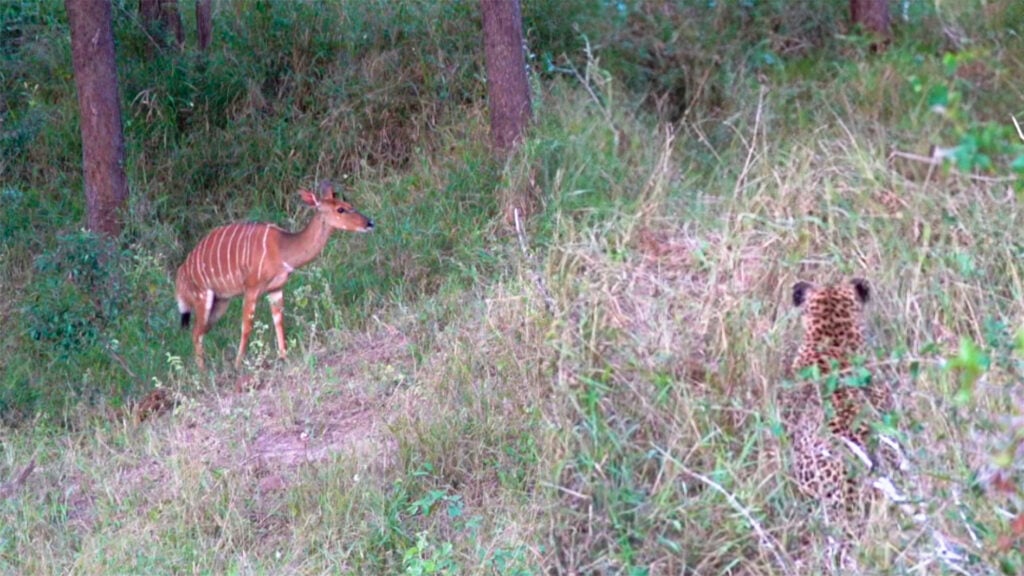
In the image below, we see the female leopard bending down to pick up an object slightly obscured by the vegetation.
In that leopards are predators, the first assumption is that she is retrieving her prey. But, as she turns to face the camera, we see that her prize is even more precious.
It’s a cub!
Lifting the object from the ground, it becomes clear that she is holding a tiny cub in her mouth. For concerned readers, this is nothing out of the ordinary.
As the following images show, leopards (and other cats) routinely carry their offspring this way.
It’s not that the cub can’t walk, it’s likely just tired and slowing her down.
Note how the cub automatically raises its hind legs and tail to avoid them snagging on obstacles as the mother carries it.
Mum and cub cooperate
And, don’t worry about her long canines doing damage. Being the caring mum she is, she only closes her mouth enough to hold the cub by the scruff of its neck without puncturing the skin.
To do this successfully requires a degree of cooperation from the cub. However, this seems to be more instinctual than learned behaviour.
That is to say that when the cub feels the mother’s jaws closing around its neck, it ‘automatically’ relaxes the upper body. Therefore, by staying still in her mouth, the cub avoids injury.
Get our Best Sightings as they Come in
Raising young leopards
As she carries her cub across the road, we hear Warick and his travelling companions gasp in amazement at the spectacle they are witnessing.
Already secretive animals, pregnant leopards will select a well-hidden den site in which to give birth, such as a cave. There, her helpless cubs will remain hidden, obediently staying put when she goes off to hunt.
If the den site becomes compromised, say, by nearby predators, she may choose to move her cubs to a safer location.
It is likely that this is what she was in the process of doing when Warick found her.
More to the story
But there is more to the story, according to him. The cub filmed was one of three cubs in the litter.
He said that the other two had walked unaided to the long grass on the right-hand side of the road, while the third lagged behind.
Consequently, the mother left them safely hidden, before returning to collect the third cub. As the video comes to an end, she is seen carrying her cub to be reunited with its siblings.
Hyperactive Baby Hippo Scares Everyone In The Waterhole
This amusing video was sent to Latest Sightings by Isa Carter. She filmed it at a water hole in South Africa’s Kruger National Park.
I’m bored!
It’s often said that an “only child” can be a challenge, especially for friends and neighbours. And, judging by the events in this video, the same is true in the animal kingdom.
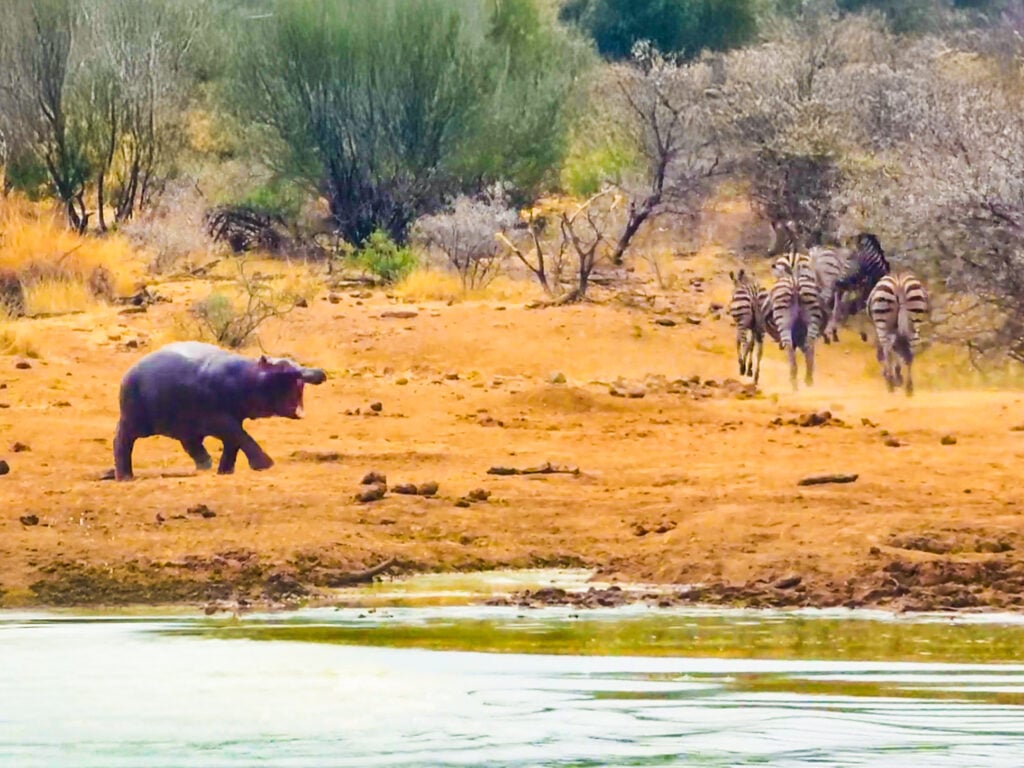
As Isa’s video begins, we see a lone hippo calf standing on the banks of its water hole. In the background, a herd of zebras await their turn to come down for a drink.
Amusing itself
It would seem that it has no one to socialise with. Nevertheless, as it runs around, it appears quite content to burn off the excess energy of youth on it’s own.
After charging around on the water’s edge for a while, it decides to return to the water, seemingly delighted at the big splash it makes.
For a chubby calf, it is surprisingly light-footed. As it takes to the water, it continues to amuse Isa and her companions with its antics. Quite what the rest of the onlookers think is open to debate.
Its mother, seen in the foreground above, seems content to watch the calf at play. Like any harried mum, she is probably enjoying a moment alone.
Thirsty zebras
Meanwhile, when the rambunctious calf took to the water, the zebras headed down to the water to slake their thirst. However, when the calf notices them, it cocks its ears in interest.
Potential playmates?
Consequently, it would seem that the calf saw the new arrivals as potential playmates. Subsequently, the over-enthusiastic calf set off towards the zebras with all the joys of youth.
Unfortunately for the little hippo, his barrelling approach was a bit much for the skittish zebras. In response, they turned and trotted away from the water’s edge.
By the time he emerged from the water, the zebras had retreated to the nearby treeline. Evidently, the hippos’ behaviour was a bit much when all they wanted was a quiet drink.
Get our Best Sightings as they Come in
Abundant energy
Nonetheless, their disappearance did little to dampen the calf’s enthusiasm. He had energy to spare and was going to burn it off one way or the other. Even if it meant playing with elephant dung…
As Isa’s video draws to an end, the little hippo, undeterred, continued to charge up and down on the lakeshore.
And, despite his protestations of innocent fun, the zebras in the background remained unwilling to join in the fun.
Playful practice
As amusing as the young hippo’s behaviour is, it actually serves an important part of its early development. Playtime for young animals is the time when they will learn the various skills necessary for long-term survival.
Hippos are highly territorial creatures, particularly in their aquatic homes. As such, while the calf may not be doing so intentionally, it is employing various behaviours that in later life will help it assert its territorial dominance.
These include charging towards intruders, patrolling the domain, and gaping jaw displays. Of course, at this stage in its life, it is all in the spirit of play.
However, later in life, these skills may mean the difference between life and death. Whatever the outcome, for us as observers, they’re both fascinating and fun to observe.
Be the first to comment on this article!