
An Unexpected Visitor at Pretoriuskop
This short but delightful clip, was filmed by Bouwe Spiekerman during a night drive near Pretoriuskop Camp. The video manages to capture a moment that feels both surreal and strangely endearing.
Under the cover of darkness, a couple of flashlights illuminated small portions of the bush. To everyone’s delight, some spotted hyenas approached the safari vehicle with what seemed like cautious interest.
Rather than circling or moving away, however, one of the hyenas leaned in closer. In a strange turn of events, it began to gently nibble and tug at the canvas side of the vehicle.
There was no aggression in its posture; instead, the behaviour looked exploratory or almost playful. It was as if the hyena was trying to figure out exactly what the unfamiliar object was.
Inside the vehicle, someone can be heard laughing quietly, clearly amused rather than alarmed by the interaction.
Curiosity Over Confrontation
Hyenas are often misunderstood as purely aggressive or dangerous animals, but in reality, they are among Africa’s most intelligent predators. This gentle mouthing of the canvas is a classic example of exploratory behaviour, similar to how young mammals investigate the world around them.
Hyenas frequently use their mouths to test textures, smells, and resistance, much like dogs do. The canvas, carrying a mix of human scent, dust, and possibly food residue, would have been especially intriguing.
In the wild, it’s important to be able to read an animal’s body language, so that you can keep yourself and the animals safe. Since the hyena didn’t attempt to tear or bite forcefully, this suggests curiosity rather aggression.
It seemed like the hyena had no interest in attempting to access anything inside the vehicle.
An Adorable Partner in Crime
Adding to the charm of the scene was the presence of a hyena cub lingering in the background. The youngster watched the adult while it wandered around, seemingly fascinated by what it was doing.
This observational behaviour is an important part of how young hyenas learn. Cubs spend much of their early lives watching adults interact with their environment, learning what is safe, what is edible, and what is worth investigating.
Get our Best Sightings as they Come in
The cub’s interest in the canvas encounter was likely less about the vehicle itself and more about understanding the adult’s response to a novel situation. Scenes like this show us how learning in the wild often happens through imitation rather than direct instruction.
A Reminder of Respectful Viewing
While this encounter was harmless and amusing, it also serves as a reminder of why strict rules around night drives exist. Remaining still, quiet, and respectful allows animals to behave naturally without feeling threatened or provoked.
The silent laughter from inside the vehicle reflects the perfect response: observe, enjoy, and allow the moment to unfold without interference.
The interaction may not have involved a chase, hunt, or dramatic confrontation, but it captured something equally special: the softer side of wildlife encounters. In the gentle nibble of canvas and the curious gaze of a cub, we’re reminded that wild animals are not just survivors, but thinkers, learners, and explorers.
Hyperactive Baby Hippo Scares Everyone In The Waterhole
This amusing video was sent to Latest Sightings by Isa Carter. She filmed it at a water hole in South Africa’s Kruger National Park.
I’m bored!
It’s often said that an “only child” can be a challenge, especially for friends and neighbours. And, judging by the events in this video, the same is true in the animal kingdom.
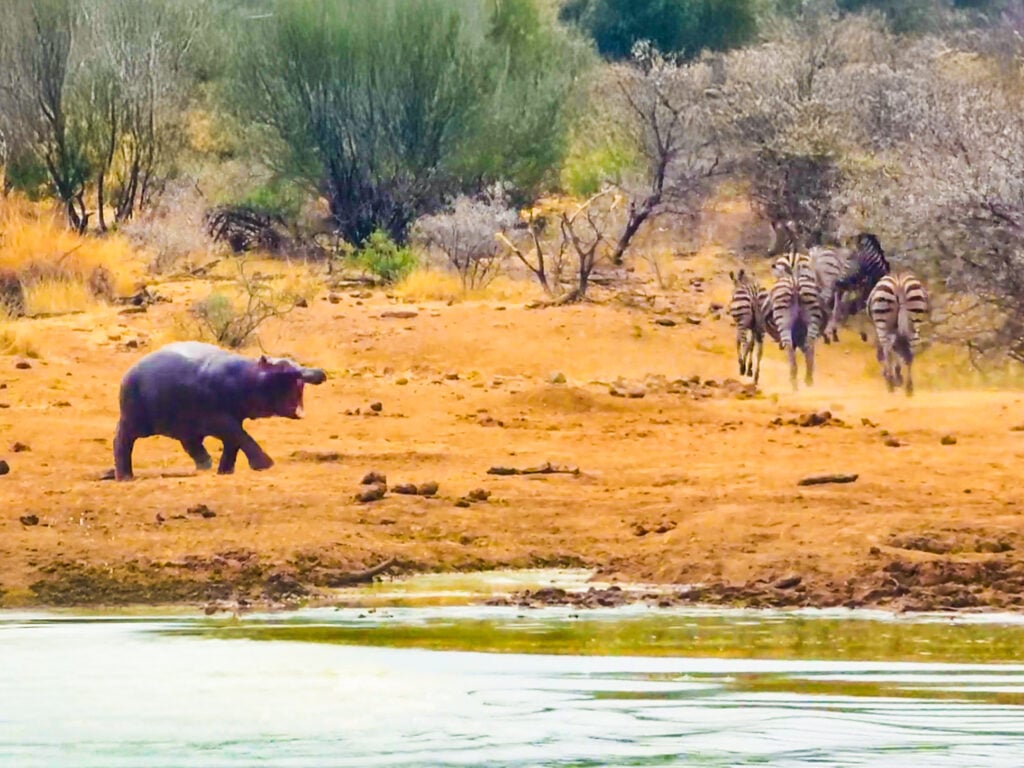
As Isa’s video begins, we see a lone hippo calf standing on the banks of its water hole. In the background, a herd of zebras await their turn to come down for a drink.
Amusing itself
It would seem that it has no one to socialise with. Nevertheless, as it runs around, it appears quite content to burn off the excess energy of youth on it’s own.
After charging around on the water’s edge for a while, it decides to return to the water, seemingly delighted at the big splash it makes.
For a chubby calf, it is surprisingly light-footed. As it takes to the water, it continues to amuse Isa and her companions with its antics. Quite what the rest of the onlookers think is open to debate.
Its mother, seen in the foreground above, seems content to watch the calf at play. Like any harried mum, she is probably enjoying a moment alone.
Thirsty zebras
Meanwhile, when the rambunctious calf took to the water, the zebras headed down to the water to slake their thirst. However, when the calf notices them, it cocks its ears in interest.
Potential playmates?
Consequently, it would seem that the calf saw the new arrivals as potential playmates. Subsequently, the over-enthusiastic calf set off towards the zebras with all the joys of youth.
Unfortunately for the little hippo, his barrelling approach was a bit much for the skittish zebras. In response, they turned and trotted away from the water’s edge.
By the time he emerged from the water, the zebras had retreated to the nearby treeline. Evidently, the hippos’ behaviour was a bit much when all they wanted was a quiet drink.
Get our Best Sightings as they Come in
Abundant energy
Nonetheless, their disappearance did little to dampen the calf’s enthusiasm. He had energy to spare and was going to burn it off one way or the other. Even if it meant playing with elephant dung…
As Isa’s video draws to an end, the little hippo, undeterred, continued to charge up and down on the lakeshore.
And, despite his protestations of innocent fun, the zebras in the background remained unwilling to join in the fun.
Playful practice
As amusing as the young hippo’s behaviour is, it actually serves an important part of its early development. Playtime for young animals is the time when they will learn the various skills necessary for long-term survival.
Hippos are highly territorial creatures, particularly in their aquatic homes. As such, while the calf may not be doing so intentionally, it is employing various behaviours that in later life will help it assert its territorial dominance.
These include charging towards intruders, patrolling the domain, and gaping jaw displays. Of course, at this stage in its life, it is all in the spirit of play.
However, later in life, these skills may mean the difference between life and death. Whatever the outcome, for us as observers, they’re both fascinating and fun to observe.
Be the first to comment on this article!