
Watch the video here:
Madelein Alexander submitted this short sequence to Latest Sightings. She filmed it at the camp fence one night, while visiting Kruger National Park.
Extra time
As night falls in the Kruger Park, many visitors mistakenly believe that the wildlife viewing for the day is over. However, others know that there is still a chance of spotting some action at the camp’s boundary fences.
This is particularly the case with those whose accommodation is close to the camp’s boundary fence. Armed with torches and spotlights, they scan the surrounding bush, hoping to see some of the nocturnal action on the other side.
Run, run, run
As Madelein’s video begins, we join her as her companion shines a light along the fenceline. As we watch, we hear her calling out, “Hardloop, hardloop, hardloop!” Speaking in Afrikaans, she is urging something to run.
Moments later, we get our first glimpse of a creature running parallel to the fence. Still hidden in shadow, it’s hard to make out what it is at first glance. Similarly, the footage gives no clue why it is running.
Jackal flash
As the light tracks the creature, it finally illuminates it enough for us to see that it is a black-backed jackal. About the size of a border collie, jackals are best known as scavengers, although they also hunt small prey such as rodents.
Having seen no prey running before it, we’re still none the wiser as to why Madelein is urging it onwards. As it disappears into the darkness, the camera pans back to the right, searching for whatever’s coming next.
Ominous shape
A few moments later, an ominous silhouette appears in the spotlight’s beam. Running with a distinctive loping gait, there’s really only one creature it’s likely to be…
Consequently, as it draws alongside Madelein’s position, our suspicions are confirmed. It is a spotted hyena, another of Kruger’s hybrid hunter-scavengers.
Like jackals, hyenas are best known as scavengers, whose powerful jaws can crack bone. While people often see both during the day, they are most active when temperatures cool overnight.
Get our Best Sightings as they Come in
Why are they there?
Quite why the hyena is chasing the jackal is unknown. What we do know is why they are so close to the camp’s perimeter.
Although strictly forbidden, unethical visitors will try lure them closer with food. They soon become dependent on the easy meal, losing their natural fear of humans.
In some instances, park officials euthanise these animals. This is a tragic outcome for an animal that doesn’t know any better.
Cat-and-mouse
Thankfully, we don’t see any indication of illegal feeding taking place here. Instead, it seems to be a game of cat-and-mouse.
After a few moments, we see the jackal come running back in the opposite direction. Luckily, the jackal has excellent stamina.
While they can reach speeds of 40 mph (65 km/h) in short spurts, they can maintain a steady pace of 10 mph (16 km/h) for extended periods.
Not long after, the hyena also comes loping by. They can run as fast as jackals; however, over long distances can maintain speeds of 40–50 km/h for several kilometers.
For the jackal’s sake, we hope this is just a game.
Hyperactive Baby Hippo Scares Everyone In The Waterhole
This amusing video was sent to Latest Sightings by Isa Carter. She filmed it at a water hole in South Africa’s Kruger National Park.
I’m bored!
It’s often said that an “only child” can be a challenge, especially for friends and neighbours. And, judging by the events in this video, the same is true in the animal kingdom.
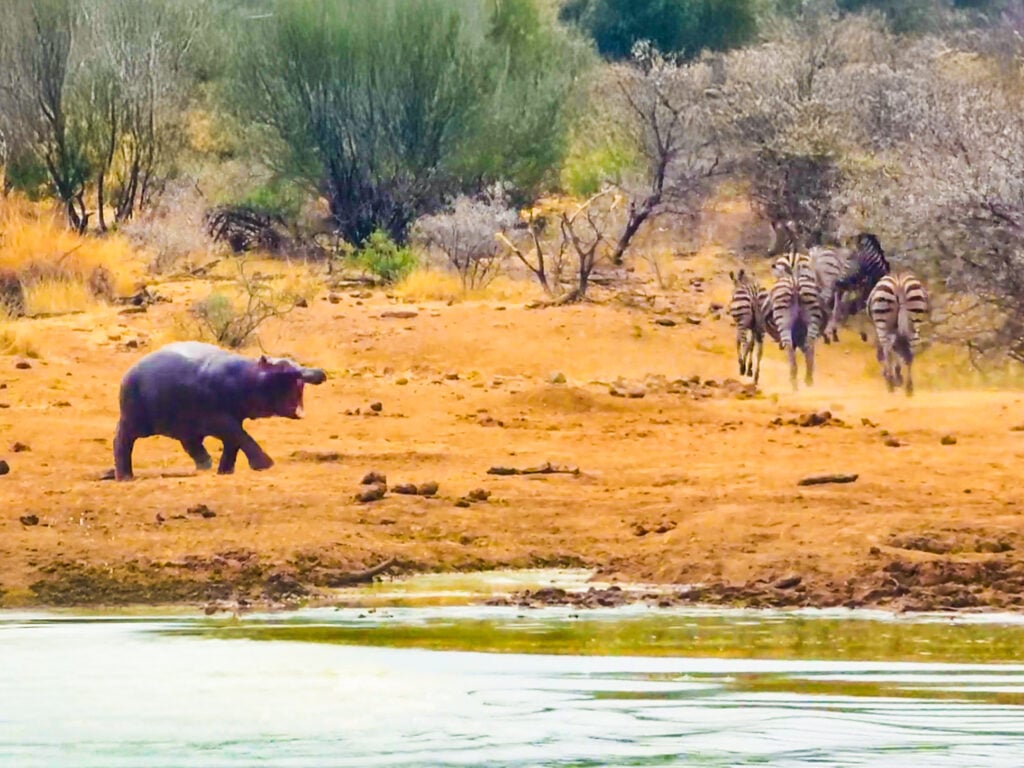
As Isa’s video begins, we see a lone hippo calf standing on the banks of its water hole. In the background, a herd of zebras await their turn to come down for a drink.
Amusing itself
It would seem that it has no one to socialise with. Nevertheless, as it runs around, it appears quite content to burn off the excess energy of youth on it’s own.
After charging around on the water’s edge for a while, it decides to return to the water, seemingly delighted at the big splash it makes.
For a chubby calf, it is surprisingly light-footed. As it takes to the water, it continues to amuse Isa and her companions with its antics. Quite what the rest of the onlookers think is open to debate.
Its mother, seen in the foreground above, seems content to watch the calf at play. Like any harried mum, she is probably enjoying a moment alone.
Thirsty zebras
Meanwhile, when the rambunctious calf took to the water, the zebras headed down to the water to slake their thirst. However, when the calf notices them, it cocks its ears in interest.
Potential playmates?
Consequently, it would seem that the calf saw the new arrivals as potential playmates. Subsequently, the over-enthusiastic calf set off towards the zebras with all the joys of youth.
Unfortunately for the little hippo, his barrelling approach was a bit much for the skittish zebras. In response, they turned and trotted away from the water’s edge.
By the time he emerged from the water, the zebras had retreated to the nearby treeline. Evidently, the hippos’ behaviour was a bit much when all they wanted was a quiet drink.
Get our Best Sightings as they Come in
Abundant energy
Nonetheless, their disappearance did little to dampen the calf’s enthusiasm. He had energy to spare and was going to burn it off one way or the other. Even if it meant playing with elephant dung…
As Isa’s video draws to an end, the little hippo, undeterred, continued to charge up and down on the lakeshore.
And, despite his protestations of innocent fun, the zebras in the background remained unwilling to join in the fun.
Playful practice
As amusing as the young hippo’s behaviour is, it actually serves an important part of its early development. Playtime for young animals is the time when they will learn the various skills necessary for long-term survival.
Hippos are highly territorial creatures, particularly in their aquatic homes. As such, while the calf may not be doing so intentionally, it is employing various behaviours that in later life will help it assert its territorial dominance.
These include charging towards intruders, patrolling the domain, and gaping jaw displays. Of course, at this stage in its life, it is all in the spirit of play.
However, later in life, these skills may mean the difference between life and death. Whatever the outcome, for us as observers, they’re both fascinating and fun to observe.
Be the first to comment on this article!