
Joan Vich managed to capture the poignant moment on film and it seems her timing was impeccable. Had her vehicle passed the site just a few moments later, she would have completely missed the mother and her cub, as they were quickly up the tree and out of view.
Mother leopard makes her way towards tree
The leopard mother had brazenly approached the tree, with her cub firmly in her grip. She held the little one by the scruff of its neck and moved with a quiet urgency.
Her behaviour presented a remarkable display of strength, instinct and maternal care. She was determined that nothing would come near her little one.
When she got to the base of the tree, she began to climb up its trunk. Her intention was to place the cub where it was relatively safe, away from the roving predators and threats which are often found on the ground.
Leopards are uniquely adapted to climb trees. Their powerful hind legs and flexible shoulders allow them to climb almost vertically, even while carrying extra weight.
A cub can weigh several kilograms, yet a female leopard can still ascend with ease, even when carrying a cub. This cub hung safely from her jaws and she carried it effortlessly, placing it tenderly in the fork of some branches, where mother and cub were relatively hidden from view.
Get our Best Sightings as they Come in

Cub lifted up into tree, away from threats on the ground
Leopard mothers often use trees as secure refuges, especially when cubs are very young and vulnerable to predators such as lions, hyenas or even other leopards.
Through lifting her cub off the ground, she was removing the young animal from immediate danger.
In addition to providing safety, a tree is also valuable in providing shade and relief during hot hours. Furthermore, being positioned at this height allows leopards to keep watch over their surroundings.
The small leopard was completely cooperative and didn’t even flinch as she carried it all the way up to the high branches of the tree.
Leopards are adept climbers and it didn’t take long for the mother to reach a fork in the trunk where it separated into branches. She had found the perfect spot where few threats would be able to reach her cub.
A successful climb
Viewing the sighting, one is almost impressed by the cooperative nature of the cub. It is actually the scruffing reflex which causes cubs to go limp and remain calm when they are carried in such a fashion. This helps to reduce the risk of falling.
This beautiful sighting was another reminder of the special bonds which exist in the wild, in this instance, a leopard mother and her little cub.
While leopards are solitary by nature, mothers will raise their cubs alone for up to two years. During this time, they will teach them survival skills such as stalking, climbing and hunting. Moments like this highlight the delicate balance between danger and care in the wild, where a single decisive action can mean the difference between life and death.
Hyperactive Baby Hippo Scares Everyone In The Waterhole
This amusing video was sent to Latest Sightings by Isa Carter. She filmed it at a water hole in South Africa’s Kruger National Park.
I’m bored!
It’s often said that an “only child” can be a challenge, especially for friends and neighbours. And, judging by the events in this video, the same is true in the animal kingdom.
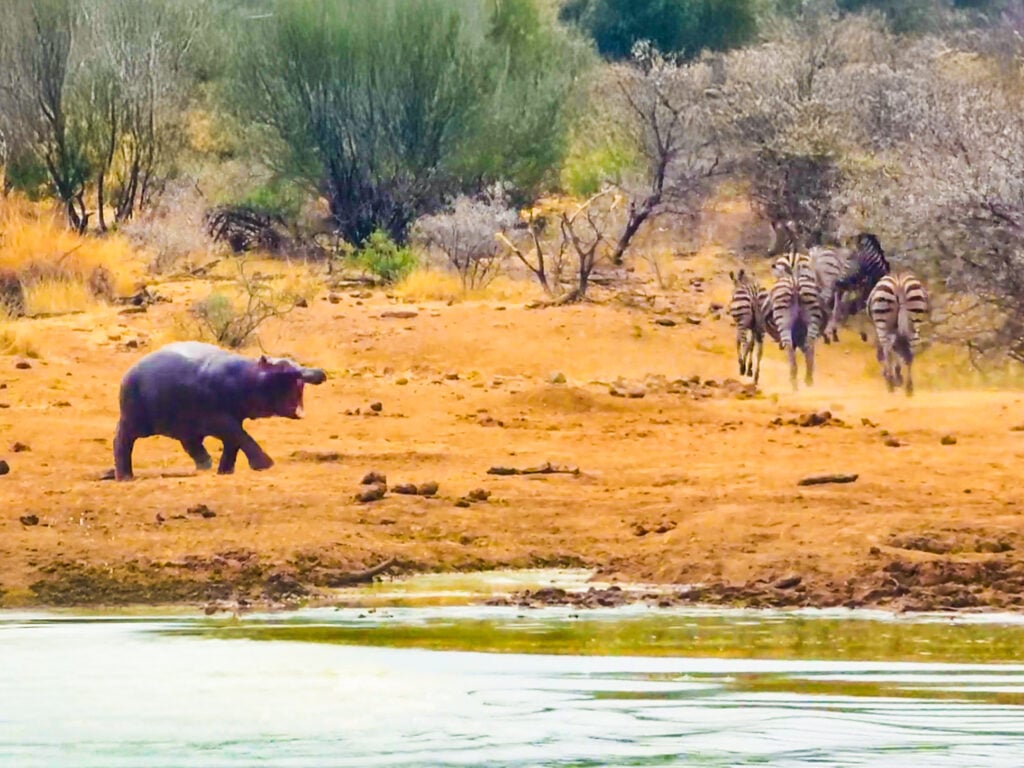
As Isa’s video begins, we see a lone hippo calf standing on the banks of its water hole. In the background, a herd of zebras await their turn to come down for a drink.
Amusing itself
It would seem that it has no one to socialise with. Nevertheless, as it runs around, it appears quite content to burn off the excess energy of youth on it’s own.
After charging around on the water’s edge for a while, it decides to return to the water, seemingly delighted at the big splash it makes.
For a chubby calf, it is surprisingly light-footed. As it takes to the water, it continues to amuse Isa and her companions with its antics. Quite what the rest of the onlookers think is open to debate.
Its mother, seen in the foreground above, seems content to watch the calf at play. Like any harried mum, she is probably enjoying a moment alone.
Thirsty zebras
Meanwhile, when the rambunctious calf took to the water, the zebras headed down to the water to slake their thirst. However, when the calf notices them, it cocks its ears in interest.
Potential playmates?
Consequently, it would seem that the calf saw the new arrivals as potential playmates. Subsequently, the over-enthusiastic calf set off towards the zebras with all the joys of youth.
Unfortunately for the little hippo, his barrelling approach was a bit much for the skittish zebras. In response, they turned and trotted away from the water’s edge.
By the time he emerged from the water, the zebras had retreated to the nearby treeline. Evidently, the hippos’ behaviour was a bit much when all they wanted was a quiet drink.
Get our Best Sightings as they Come in
Abundant energy
Nonetheless, their disappearance did little to dampen the calf’s enthusiasm. He had energy to spare and was going to burn it off one way or the other. Even if it meant playing with elephant dung…
As Isa’s video draws to an end, the little hippo, undeterred, continued to charge up and down on the lakeshore.
And, despite his protestations of innocent fun, the zebras in the background remained unwilling to join in the fun.
Playful practice
As amusing as the young hippo’s behaviour is, it actually serves an important part of its early development. Playtime for young animals is the time when they will learn the various skills necessary for long-term survival.
Hippos are highly territorial creatures, particularly in their aquatic homes. As such, while the calf may not be doing so intentionally, it is employing various behaviours that in later life will help it assert its territorial dominance.
These include charging towards intruders, patrolling the domain, and gaping jaw displays. Of course, at this stage in its life, it is all in the spirit of play.
However, later in life, these skills may mean the difference between life and death. Whatever the outcome, for us as observers, they’re both fascinating and fun to observe.
Be the first to comment on this article!